Do You Really Need A Website for Your Business in 2020?

In recent years consumer behavior has changed with evolving technologies in the digital era.

Nowadays, you have a website for everything. From nail arts to social campaigns there are websites owned by big enterprises as well as small companies. Yet, there are hundreds of businesses behind the times.

According to Adaptive Marketing, in 2017, 97% of people searched online to find a local business near them. Therefore, if you want to grow your business by being in front of the right audience, you need to be found online – implying you must have a website.

Still not convinced? Here are a few reasons why you need a website for your business in 2020.

Websites offer social proof

Customer behavior mostly depends on what you have to say about your own business.

No matter your brand got a 5-rated star on Google or Yelp, people are always interested to find out what your view is about the brand. Having a website will provide certain information that won’t be available otherwise. Impressed buyers, live images, live testimonials, these are sort of social proofs to get people interested in your company.

According to Beam Local, in fact, 56% of people stated that they won’t trust a business without a website.

Websites can control the narrative

Being in a public forum is difficult especially to control what people say about you. However, with a website, you can influence your brand perception by writing your own story.

According to SEOTribunal, there are 5.6 billion searches on Google per day, and 63,000 searches per second on any given day. So if you don’t give an effort to make your business more relevant online, there might be a chance that you are losing business to your competition!

Websites generate more ROI

As mentioned above, with 63,000 searches per second can you imagine how many people might be looking for services you provide? A search engine optimized website lets you be in front of thousands of more potential consumers without spending much. It can help you reach a wider target audience for promoting your services or products.

A website can help showcase your expertise and better position your business. This, in turn, helps you to generate more traffic to your website.

Making a website is not that expensive

It may sound all glamorous & expensive, but in reality, with so many tools in the market, making a standard website doesn’t cost that much.

There are so many website development companies, like us, who can provide a great user-interactive website within a moderate budget.

Of course, later you can always improve it as the cash comes in. If you’re planning to market your business, a website should be your first priority.

Website can overpower social media

Facebook claims that people in 2018 spent 50 million fewer hours on Facebook than they did the year before.

This might the fact that social media is fading in its reach. Therefore, many companies are now switching to building websites instead of relying on social media networks only.

Website can showcase your offers

The website gives you full control of how to run your business online. You can add offerings with features but also provide short video tutorials or downloadable PDF instructions. You can also highlight your awards, testimonials and all the features that can alleviate your visitors’ pain points.

A business website can give you a competitive edge

Bidding for the right keywords can increase your website traffic and influence your consumer’s journey, which typically begins with research, recommendations, and reviews.

Having a cool website with the right keywords will earn you proper visibility online, a great way to challenge your competitors.

How to start your website?

Now that you have all the reasons why you need a valid website here are some tips to get started.

Choose a Domain Name

Very important.

If you are lucky you might get a domain name based on your company. If it is not available, you can choose a domain name that reflects your business line. Make the domain name catchy and distinctive.

Decide what kind of look you want for your website

This will be completely based on your company’s service & your target audience. Of course, if you are a fashion designer your look would be very different from, say a security agency.

Find a website designer & developer

An efficient designer & developer is the sole behind an impressive website. It is best to hire a design & development company as they would have all the required services that you need.

Make sure your website template is easy to navigate and doesn’t resemble your competitors. After all, you don’t want your business to look similar to your competition.

A full-fledged market plan to promote your website

A website is like a product. You need to optimize it & promote it well enough for your viewers to navigate it.

Hire a digital marketing agency that knows what exactly they are doing. Discuss your vision, your business plan & target audience & they would customize a well comprehended digital to promote your brand.

Remember, a website is an integral part of your branding. So the more you invest your time & energy to make it perfect, the more it will fetch you results.

Having a professionally designed, brand-differentiating website is critical to increasing sales, boosting the bottom line, and growing your business.

Have you cumulated a website yet? Or need your website updated?

Contact Skyram Technologies We will not only provide you with a well designed user-friendly website but also will give you the perfect plan to promote it. Connect with us here.

And for our other blogs read here!
Importance of App Store Optimization

App Store Optimization or ASO is something often overlooked by many developers or marketers.

However, with over 2 million mobile apps in major play stores, being at the top of the store to get noticed can be very difficult, forget downloading.

Now the question is how to get higher ranking in app stores?

The answer is ASO or App Store Optimization.

What is App Store Optimization?

Simply put, ASO is a process of optimizing mobile apps to rank higher in the app store’s search results. Obviously, the higher the rank in the app store’s search results, the more visible it is to potential customers.

Look, not everyone has the capital to spend huge amounts of money on app development; ASO is your new secret weapon.

But, ASO requires a crucial understanding of your target customers along with a keyword that your customers might be using.

Why is ASO an important marketing strategy?

As mentioned earlier, with over 2 million apps available on major app stores, optimizing your app will simply give you an edge over the others.

A simple app store search drives a staggering 67% of app downloads, making search within the app stores the most common method for discovering and downloading new apps.

What are the benefits of ASO?

Organic Installs

One of the best things about ASO is that it is extremely beneficial when you don’t have a high budget.

After you have optimized your app will start ranking higher for different search results, improving your visibility and increasing your organic downloads, all whilst keeping your acquisition costs down.

Increased Revenue

ASO makes your app more visible in the play store, therefore it will benefit you in terms of increased revenue from all the extra downloads you are receiving.


Finding Relevant Users

The most important aspect is the relevancy. You need to focus on the proper keywords your target users are searching for. Otherwise, your app won’t be able to explain what it does, or how it works. All of these factors reduce the chances of getting your app in front of the right user.

Stability

In terms of business, a little extra boost or extra downloads, in this case, will earn you a better place in the market.

While paid marketing may sound enticing. But it lacks a long-term solution. Once the downloads slow down it may be tempting to up your marketing budget further but this is not always a profitable option and the money will eventually run out.

How does using keywords help in ASO?

It is the same as using keywords in your blogs or social media. It is important to notice the difference between “competitive” keywords and other difficulties.

As you can see from the graph above, “competitive” keywords make your app rank much higher.

Your main keywords must be included in the full name of your app. Make use of the store’s search auto-complete option to help you recognize popular keyword combinations that you might have missed.

What are some of the factors that affect ASO?

Title

It is basically the foundation of your app. The words you add in the title act as keywords. So be sure that you add high ranking words. Also, be sure that the keyword has a good balance between keywords and branding.

App Description

This one describes what your app actually is. Choose keywords while writing the description because without doing any research on keywords, most apps are seen hidden in the app stores.

App Icon

It is important that your icon stands out. A sleek simple design that represents your brand will make you stand out among the crowd.

Video Demo

This is the most interactive way to present your app to the audience. Creating a video and showcasing the details and working on your app can help you get more downloads.

Rating & Reviews

Apps with higher ratings are ranked higher generally. Good reviews can increase the quality of the app in the store. Developers should encourage their customers to give reviews and try to resolve negative issues as soon as possible. Keep communication channels open to users for feedback.

Keep in mind that ASO takes time. It is a process that needs to be monitored & constantly tweaked over a period of time to give relevant results. App developers need to consistently track their own rankings and the rankings of their competitors over time. More apps are published every day, and the constant stream of new ratings, reviews, and downloads can affect your search rankings.

So take your time & more importantly get some professionals for the job.

Doing it on your own may not give you beneficial results.

Want some help? Contact us at Skyram Technologies. Our expert developers & marketers will provide you with the perfect ASO plan for your app. Connect with us here!

And for more such blogs read here!

Rise of Infographics in Digital Marketing

They say words have a magical power of their own. Also, a picture speaks a thousand words.

But what about when two of them meet? Imagine how powerful that would be.

Yes, I am talking about infographics.

It has been studied that infographics can provide exceptional results in digital marketing.

Kissmetrics tells that within a two year time, from 2010 to 2012, 47 infographics generated 2,512,596 visitors and 41,142 backlinks from 3,741 unique domains.

This means that each of them generated 53,459 visitors and 875 backlinks from 79 unique domains. When it comes to social shares, each one generated 879 tweets and 443 likes.

Now before jumping into why infographics are so important for quick results, let’s understand what is infographics.

What are infographics?

Well, going by the Oxford English Dictionary, an infographic simply refers to “a visual representation of information or data”.

It is a collection of imagery, chats, texts which gives an easy-to-understand overview of the topic.

When exactly do we need infographics?

Infographics can be used in many ways obviously.

Suppose you need a complex piece of information that needs to be described quickly, precisely and clearly, a graphic is suitable.

They are often used for signs, data representations, maps, etc. And let me tell you, they are used not only by digital marketers, but they are also used by scientists, technical writers, mathematicians, educators and statisticians for the ease of understanding any complicated data.

What are elements which make an infographic?

An infographic should have three major elements.

Visual Elements

  • Color coding
  • Graphics
  • Reference icons

Content

  • Time frames
  • Statistics
  • References

And Facts.

Why use infographics in digital marketing?

If you are struggling to find relevant traffic to your website then you need to use infographics as a part of your internet marketing campaign.

Here are some of the reasons why.

To easily Catch Your Targeted Audiences’ Attention

Humans are visual creatures and because of this people are easily attracted to visual elements that attract their attention. People need the “optic nerve” activated in order to process the more than 90% of information that comes into one’s mind, and all these are visual information.

Accompanied by a well-written text, infographics can be a solid tool to get the information into your audience’s mind in this world of information jungle.

Increasing brand awareness

Creating a brand identity is a necessity nowadays.

Infographics along with the vital information carry your brand’s logo, at times even your brand’s color palette.

As these are designed to include relevant information, people sort of have a trust that builds up with the company.

Infographics go beyond merely “telling” people about what your brand, products or services are – it “shows” them with visual content which is far more effective than mere paragraphs of text.

Increase your marketing results

Infographics not only are designed with your contact information, sharing or embedding the material in social media or other online channels can generate important backlinks to you.

The results are an abundance of inbound links that can really boost your search rankings. You can make this better even more by adding highly targeted keywords as part of the title, description and meta information of your Infographic.

This can go really well for your business as up to 60% of consumers will have the most probability of contacting your business if they see your images, in this case, an Infographic, as a relevant source for their needs.

Builds trust among your audience

Nowadays, a well build connection is very essential for any brand.

The research required to create an infographic will display your knowledge and position you as an expert on your category or topic.

This way people will begin to trust your brand a bit more.

Helps to boost your SEO

According to reports, more than 5 million online content is created every day. Thus without something which will stand out from the rest of the crowd, your brand may never be able to get beneficial results.

Infographics have a chance of getting viral, which means better SEO.

The viral nature of the infographic medium makes people link to your site and Google will index your website higher due to Google’s “Page Rank” algorithm.

As a result, your brand will go viral throughout the web, and you will get more subscribers and followers.

Some points to keep in mind while creating an effective infographic:

While colors & fonts may be alluring, it is the content that really matters while creating a good infographic.

So here are some points to keep in mind for engaging infographics.

The content & facts

The more relevant facts you provide in your infographic, the easier it is to engage your audience.

Information flow

Look, infographics are used for people to understand a piece of complex information in a simple manner. So make sure that your information flow is right.

Don’t use too many colors

Using more than 3 or 4 colors in an infographic can make it look busy. Use 3 colors preferably contrasting ones to make it eye-catching.

Use negative space

Proper use of white space or negative space is important while creating any sort of graphics.

Doing research & citing your sources

Infographics are all about citing proper facts, so mentioning sources gives it proper relevancy.

Also, do your research well before creating any infographics.

Few examples of good infographics:

infographics 1
infographics 2
infographics 3
infographics 4

Well, now that you know all about the importance of infographics, it is time for you to implement that in your content marketing.

Need some help? Contact us at Skyram Technologies. Our expert research team & graphics designer will deliver you with some original infographics perfect for your marketing campaigns. Connect with us here!

And for more such blogs, contact us here!

Augmented Reality (AR) & Virtual Reality (VR) in Movie Screening

Movies are one of the popular forms of entertainment.

With emerging Netflix, Amazon & other streaming platforms, movie viewing has now become like a daily staple for everyone!

Moviemakers are always on the verge to entice moviegoers into theaters—and what better way to do that than with technology? Technology has clearly changed other historical institutions, like sports, and the movie industry is no exception.

Right from Cameron’s Avatar in 2009, implementing AR & VR in animation, science-fiction, fantasy has become a trend in the movie business.

IMAX screens offer immersive viewing experiences that rival those seen in theme parks. D-Box seats offer movie viewing in 4D, allowing you to feel on-screen explosions and ride along in a car chase as your seat tilts with the turns.

VR
Pic from: Theatre Company

Then, obviously, with technologies like motion-capture and computer-generated imagery (CGI) which are honestly quite an old concept.

Moviemakers, especially in Hollywood, are using their collective energy into using VR to tell stories as well as immerse moviegoers with brand new adventures.

How Virtual Reality or VR is used in making movies?

To be honest, integrating VR in movies has it’s fair number of challenges.

Generally, there is no behind VR camera, so directors have to direct his actors from a distance, and that unlike in 2D he couldn’t edit footage to hide one actor’s bad take.

Also for the actors, let’s take a situation.

You are an actor acting on a film set which is basically green in color. The whole set is being created digitally. So obviously it lets a difficult to put out the raw emotions as you won’t be able to fully understand the world you are in.

Cost & demands of VR effects in films

Of course, another reason VR attracts big-name directors is that filming high-quality VR movies can come with a significant price tag.

Apart from the usual costs of production, staff, actors, post-production, etc., there are specialized 360-degree cameras and hiring staff to stitch together video can cost upwards of “$10,000 per finished minute” of footage, according to The Hollywood Reporter.

Still, there is no shortage of filmmakers trying their hands on VR technology.

How Augmented Reality is used in movies?

More than the making, AR has changed the way films are promoted, completely.

Film studios can generate hype and buzz bringing an interactive journey to its fans.

To get a glimpse of the new movie, movie buffs can just point a mobile phone at a movie poster, city light, billboard or printed advertisement. Instantly, they will get more information about the movie and enjoy an interactive experience.

Employing augmented reality elements for movie promotions calls for a detailed analysis and a highly orchestrated promotion plan as there lies a thin line between innovation and illusion.

Do you remember The Amazing Spider-Man 2?

The movie was among the first few ones to create AR-based promotions. People in shopping malls or retail stores or bus stops could scan the codes embedded on the walls & a spider man can be seen crawling up the walls, swaying from the buildings and showcasing some patron stunts loved by all.

Also, a spidey costume creator wherein you can dress up like a spiderman and share the images with your friends and family was introduced to promote the movie. This, in fact, created an added buzz for the already super-successful franchise.

Some movies to execute VR technology successfully

Here are some of the movies from the last decade where they used AR & VR to its full effect.

Avatar

One of the first movies to show the 3D effect also implemented AR in some of its seen.

 Avatar 2009
Avatar 2009

Like the big map in the HQ that shows the Na’ vi’s tree, the stacks of spaceships that use HUD screens to navigate or the plenty of toys in the researcher’s lab. Take your pick.

Iron Man

Well, Iron Man started it, but the whole Avengers movies showed the large scope of AR & VR.

Iron Man’s suit is so kitted out with AR goodies that it gives stacks of real-time information so that Tony Stark can do what he does best. The Iron Man films are great examples of how AR could work for future soldiers with a mainframe computer feeding live data to combatants in the field.

Minority Report

Yup, there is a whole scene in the movie at the beginning where Tom Cruise uses his hands to find information in three-dimensional computerized space and then there’s all that AR down at the shops when the adverts start telling him what’s on offer that he’d like.

Well, Steven Spielberg showed a world around 2054, but in reality, the AR elements have been integrated into movies a lot quicker.

Wall-e

One of the most favorite animation movies of all time executed the use of AR.

There is a scene where the cleaning robots who use a scanner to analyze the amount of dirt on Wall-e before chasing after him.

Another time when the “Buy ‘n’ Large” displays of people on the cruise spaceship that lets them see a very different world to the one they should see.

What is the future of AR & VR in films?

Moviemaking has always been propelled by technology.

However, VR has a long way to go before being fully adopted by the film industry mainly in countries like India who are trying to adopt the technology.

As future headsets improve in graphical quality, frame rates, and physical comfort, longer VR sessions will be less prone to eye strain and nausea.

Even with TV entertainment and production values that rival film, it’s not too far-fetched to think in the future, you’ll go to the movies for a completely customized movie experience.

How are you planning to implement AR or VR technology in your business?

Think about it. And if you want some help contact us at Skyram Technologies. Our experts will guide you through to make a perfect AR-based technology for your business. Connect with us here.

And for more of our blogs, read here!

Machine Learning in Weather Forecasting

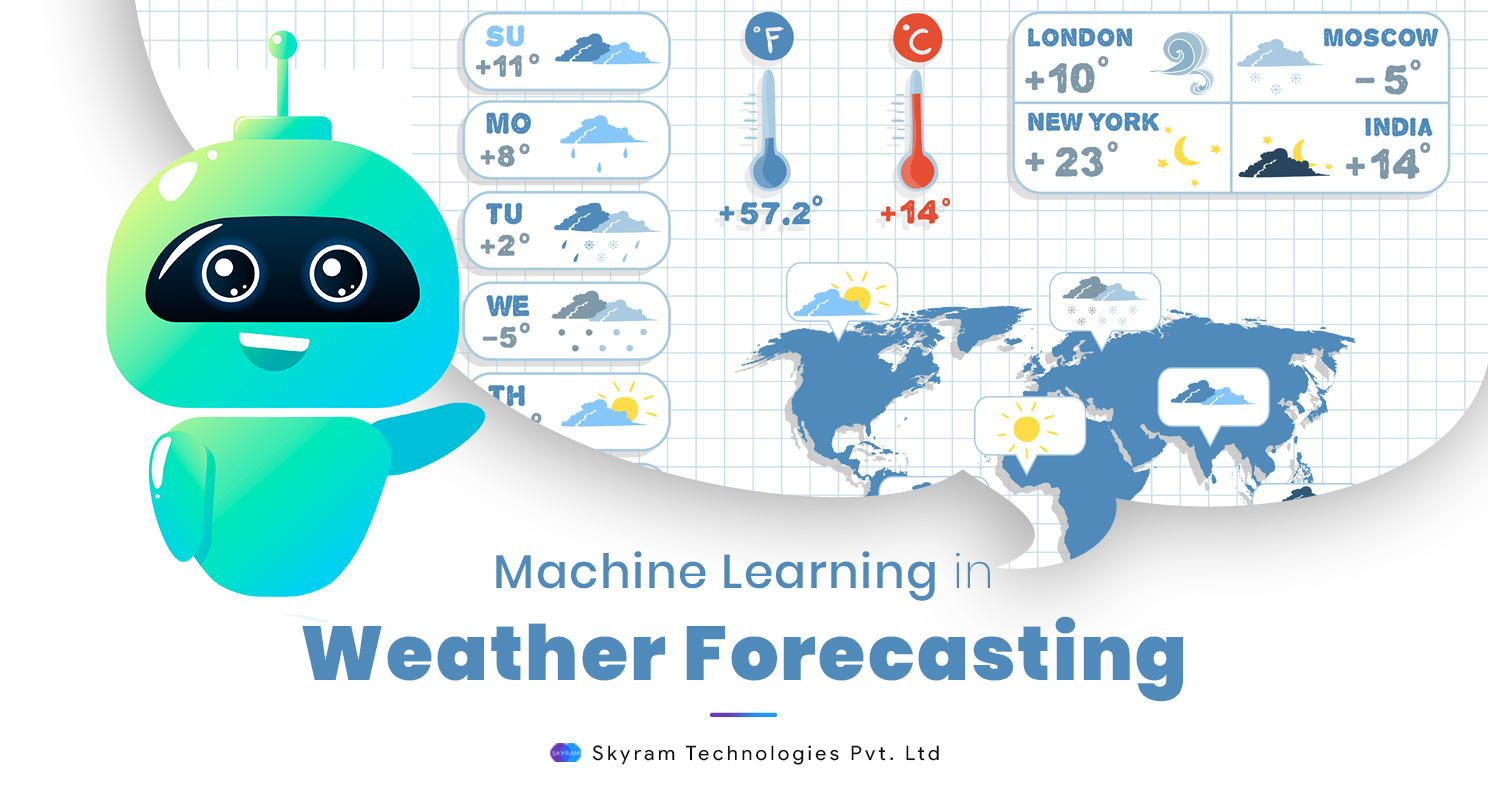
Weather forecasting can be an uncertain job. Traditionally, this has been done through physical simulations in which the atmosphere is modeled as a fluid, where future predictions were done based on the present state of dynamics.

However, this process has some uncertainties as understanding the complex process of atmospheric conditions is pretty unpredictable.

Think about it, how easily the weather change nowadays? Can you actually predict anything at all?

That’s why machine learning is gaining so much importance in the field of weather forecasting.

But before discussing that, let’s understand what machine learning is.

What is Machine Learning?

According to a Springer Link paper, “Machine Learning (ML) is the scientific study of algorithms and statistical models that computer systems use to perform a specific task without using explicit instructions, relying on patterns and inference instead. It is seen as a subset of artificial intelligence. Machine learning algorithms build a mathematical model based on sample data, known as “training data”, in order to make predictions or decisions without being explicitly programmed to perform the task.”

It is closely related to computational statistics, which is basically using computers to make predictions.

Now, machine learning is based on AI & has a plethora of algorithms, models & approaches but we will keep that for another day.

Why use machine learning in weather forecasting?

With machine learning, it is relatively robust to perturbations and doesn’t require a complete understanding of the physical processes that govern the atmosphere.

Before the advancement of technology, weather forecasting was extremely difficult. Weather forecasters relied upon satellites, data model’s atmospheric conditions with less accuracy. With the advancement of Data Science, Artificial Intelligence, Scientists now do weather forecasting with high accuracy and predictability.

In today’s world where Global Warming is a serious issue, we need advanced technology to predict the uneven pattern of storms, hurricanes, cyclones or floods.

Right now, there is a lot of buzz around applying descriptive ML in hazard detection, especially to storm tracking.

Trained experts are able to recognize storms and trace their paths from weather imagery which will be a great achievement for the parts of the world with a high probability of natural calamities!

What technology is being used for weather forecasting via machine learning?

Well, to begin with, we need to talk about the two most important in predicting the weather, which is Linear Regression and a variation of Functional Regression.

These models are trained based on the historical data provided of any location. Input to these models is provided such as if predicting temperature, then minimum temperature, mean atmospheric pressure, maximum temperature, mean humidity, and classification for 2 days.

With the help of these models, we can actually predict the maximum & minimum temperature of 7 days at least.

Another company is Google, which is trying to prefect weather forecasting is using ML programs.

How Google is planning to use machine learning to predict the weather?

Have you heard about the Butterfly Effect?

It is basically a technology where any small change in a complex phenomenon can have a significant impact on the outcome, stays true to the process of weather forecasting, where a slight amount of change in one variable could drastically change the future climatic events.

Weather is really unpredictable & that is exactly where AI plays a huge role.

One of the most significant advantages of this trained ML model is the speed at which it can forecast the weather.

Google with its new model of ML would only take 5-10 minutes to generate a forecast, which used to carry around six hours earlier. This is because the newly trained model doesn’t try to model a complex weather system; instead, it makes predictions on simple radar data.

According to the paper submitted by the company, “As weather patterns get easily altered by climate change, which can lead to increase in extreme weather, it becomes crucial for weather departments to attain actionable insights at high spatial and temporal resolutions,”

How ML Algorithms are used in predicting the weather?

Weather Forecasting using Machine Learning Algorithms is primarily based on simulation-based on Physics and Differential Equations. Artificial Intelligence is also used for predicting weather. This basically includes models like Neural Networks and Probabilistic model Bayesian Network, Vector Machines.

Neural Network is widely used to capture non-linear dependencies of past weather trends and future weather conditions.

Another example of the ML application is that descriptive ML can address the challenges posed by data volume and complexity when dealing with data from physical simulations.

So basically, these highly multidimensional models could summarise the salient features and bring them to the forecaster’s attention would help streamline this task.

The future of weather forecasting

As machine learning advances and more weather models start integrating it, weather forecasting will become increasingly accurate.

There is so much scope & potential of global nowcasting, which is a relatively new addition to weather forecasting. Weather, machine learning can be added to weather forecasting to extend nowcasting to places such as Russia that lack widespread radar coverage.

As smart system penetration grows worldwide, more people will gain access to accurate, hyperlocal weather forecasting as well.

Well, how are you planning to implement machine learning & AI into your business? Want some guidance? Talk to Skyram Technologies. Not only guidance, we will develop AI programming perfect for your business! Connect with us here.

Also, for our other blogs on AI & machine learning, read here!

Future of Retail Online & Offline

Amazon, Myntra, Flipkart, online shopping, E-retail.

You must be well accustomed to these words by now. Not a day passes by without hearing these buzzwords at least once in a day.

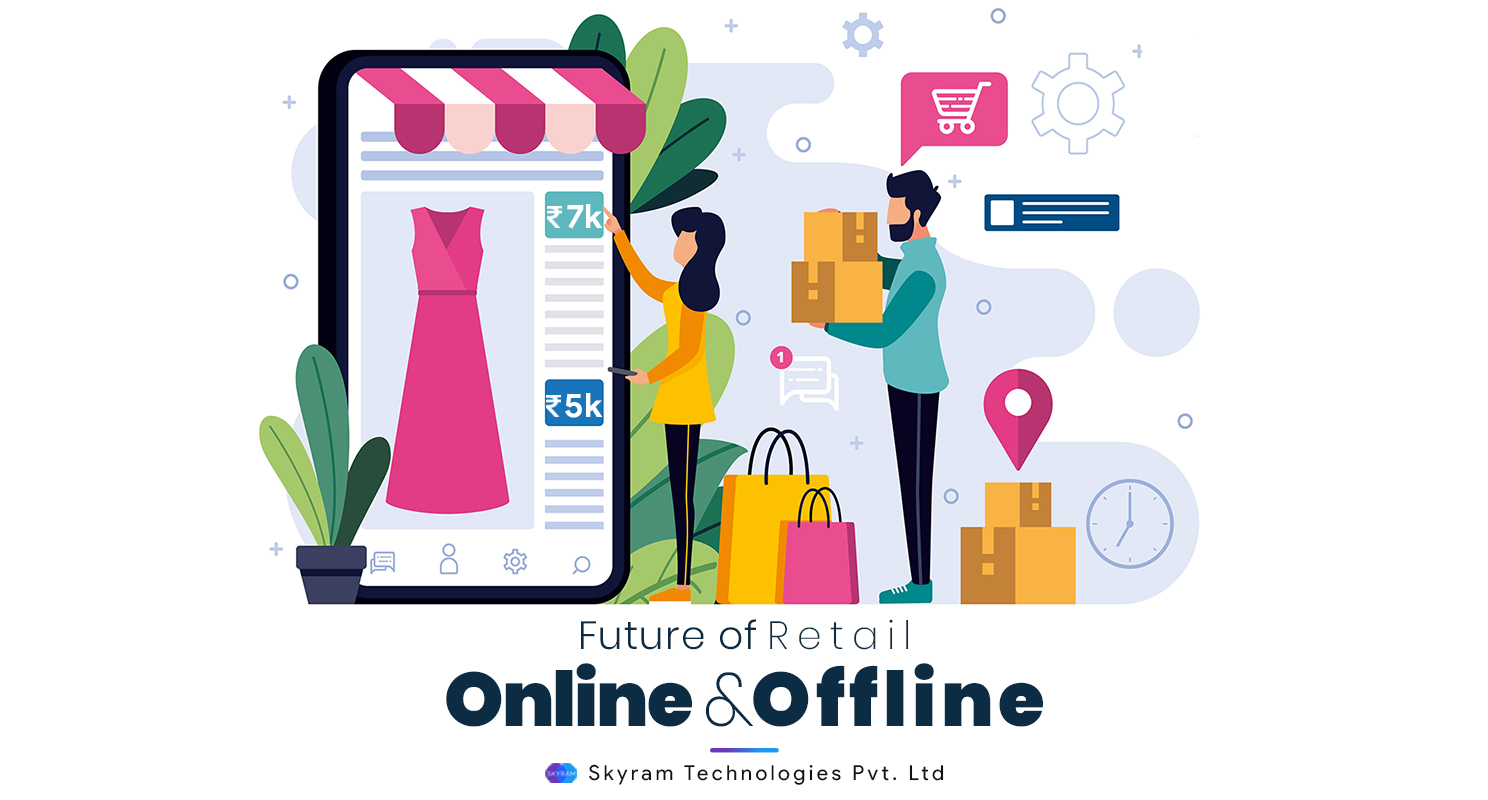
Online retail stores have completely revolutionized the entire retail and trade scenario, expanding a brand’s geographical reach and opening up a whole new world of customers.

But one question that pops up in our mind regularly alike is whether eCommerce will take over physical retail entirely.

Well, there is no definite answer to this.

However, to give you a better perspective, here is our take on the retail offline & online industry.

What is the current scenario of the retail industry?

The online e-commerce sector is growing fast & wide.

By 2019, the sector is said to have touched a whopping $1500 billion worldwide!

Now, the factors leading to this phenomenal growth are four-sided.

  • The physical store, through payment gateways and digital catalogs, is moving online.
  • Social media plays a very big role. With diverse platforms, you can now use text, visuals, audio, and just great pictures to promote your products.
  • The age group of 18-24 years prefers to shop more online compared to their older counterparts. This can possibly be attributed to this being the first generation that grew up alongside the internet.
  • The rise of smartphones & the use of apps improve access to online stores and can even build brand loyalty. This is one reason so many online stores ask consumers to install their apps.

However, despite such an impressive growth in the online sector, about 36% of all shoppers mostly prefer to buy from a physical store. Like designer items or jewelry, they are high-value items where people like to go offline.

What are some of the advantages of offline retailing?

  • One of the greatest advantages of offline shopping is the trust issue. You can actually see, feel & test the product before buying.
  • Establishing a brand exclusively online can be daunting, considering the largest gateway for discovering these products is Google.
  • Moreover, people may prefer to shop in groups and the option to do so is effectively non-existent in online stores.

How the two sectors are blending?

At present many marketing experts are trying to go omnichannel retail.

What is omnichannel you may ask?

Well, it is sort of a hybrid between both online and offline retail where they function as one single entity.

According to an AT Kearney report, a stunning 95% of sales are achieved by brands that have an offline presence.

There are a few other things brands can look into to make this hybrid retail experience seamless.

One is to keep the brand identity intact. This way consumers won’t get confused between the two.

Second, offering in-store pick-ups for online sales and letting customers experience a product in-store before buying online are some ways to integrate both. This way you are providing the best of both worlds.

Going with future predictions, according to analysts omnichannel is going to be the future.

How will the purchasing algorithm of customers affect retail in the future?

The future of retail will probably be dominated by AI-based virtual assistants and purchasing algorithms, which will help to make our life easier and deliver the most convenient of the possible convenience.

Online Retail
Online Retail

So effective algorithms that can take control of categories for the consumers, by providing them time and cost-efficient undifferentiated solutions, will be a major hit for consumers.

This will be a challenge for multi-brand retailers. The promotional activities will be focused on algorithms. Brands will have to work to make them relevant to ensure that either the algorithm won’t trade them down, or the consumers will care enough about the brand to keep it in their own selection.

What does it mean for offline retail businesses?

Well, popular predictions say that a large section of the consumers will move online completely, but statistics show a different scenario.

Some products like mobile phones, computers, and electronics are expected to move online with a 9% increase in online purchases.

Also, sports equipment and clothing are predicted to increasingly be purchased online with a 6% increase and a large 11% rise within Generation Z.

On the other hand, segments like groceries, foods, fresh vegetables are expected to have a decline of 12% to 9%.

Moreover, gardening products, shoes, alcohol, hygiene products are expected to shift towards offline retailing.

What position does India hold currently in the retail market?

Well, the good news is that India is achieving some splendid job in the retail development index.

In Retail Development Index 2017, India was ranked the first in the Indian retail industry as the world’s fifth-largest global destination leaving the Chinese market behind.

According to reports, it accounts for over 10% of the country’s Gross Domestic Product (GDP) and around 8 % of the employment.

Recently, Rajesh Jain, MD & CEO at Lacoste India (Sports And Leisure Apparel Ltd.) mentioned that the Government of India’s various initiatives to enhance the retail industry in India is seen as a positive step forward.

According to reports, India’s retail market is said to be the world’s third-largest consumer economy reaching US$ 400 billion in consumption by 2025.

Do you want to open a solid retail market online? Contact us at Skyram Technologies & let us guide you through your business goals.

Also, for more such blogs read our blogs here!

Virtual Reality (VR) & Augmented Reality (AR) in 2020

Do you remember the time when Pokemon Go was making everyone crazy? It was the year 2016 when this particular game had everybody hooked on to their smart-phones obsessively till they find Pikachu!

For us who did not rely on got-on with the trend kept wondering why on earth everybody was so obsessed with this game, running around the streets looking for Pokemons?

Well, it was the first time when AR took the spotlight! Obviously, not all of us know that the whole thing was based on this particular technology, but we were engrossed by the crossover of the real-virtual world on such a massive scale!

Well, by now, both AR & VR technology has taken the industry by storm, be it healthcare, films, marketing, even farming.

But before going into further details, let’s talk about the difference between AR & VR.

What is the difference between AR & VR?

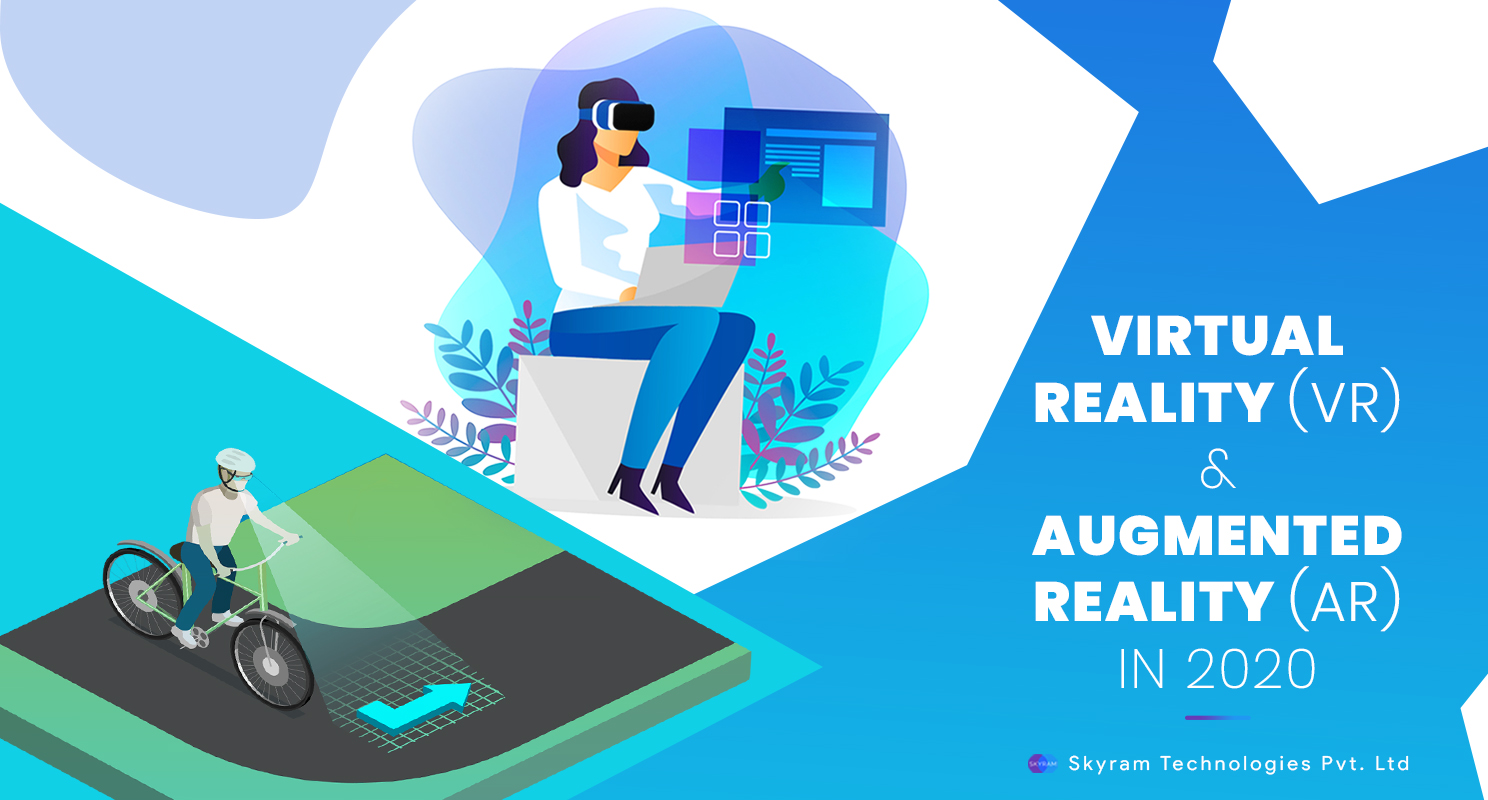
Augmented Reality or AR adds digital elements to a live view often by using the camera on a smartphone. It is more of an interactive experience of a real-world environment where the objects that reside in the real world are enhanced by computer-generated perceptual information.

Another example apart from Pokemon Go is Snapchat lenses where you can add various filters & even Instagram for that matter.

Virtual Reality or VR, on the other hand, is a much more intensifying experience where there is a complete immersion experience that shuts out the physical world.

Google Cardboard is a great example of VR. Here while watching anything users can be transported into a number of real-world and imagined environments such as the middle of a squawking penguin colony or even the back of a dragon.

There is another concept that is gaining quite a lot of momentum now- Mixed Reality or MR.

In MR experience, which combines elements of both AR and VR, real-world and digital objects interact. A popular example of MR is Microsoft’s HoloLens!

But that’s a topic for another day.

AR & VR in Healthcare

The medical & healthcare sectors have embraced both the technologies in a big way!

Right from diagnosing a patient’s illness to training new doctors and more, it finds multiple uses in the healthcare industry. AR & VR is widely used in hospitals to improve surgery, treating psychological & neurological patients, improving management systems, also a part of hospital care.

In fact, AR & VR in the healthcare market is predicted to grow at a 30.2% CAGR over the forecast period (2018-2023), states the new Market Research Future (MRFR) report.

Going by region, according to the latest reports, America is leading following it will be Asia Pacific, Europe, & Middle East as well. After America, Europe is predicted to have the second-largest share in the market over the forecast period. But Asia is tuning up their game as well.

If you want a more detailed view on the use of AR in the healthcare sector, here is the link to our blog.

AR & VR in Marketing

According to the Economist Intelligence Unit, 26% of senior marketers believe that virtual reality will have the biggest impact on marketing by 2020.

Future Trends 2020
Future Trends 2020

For the marketing world, VR & AR means a whole new world of opportunities.

One of the best ways to market anything is by telling a story & VR will exactly allow that. It will build allure the consumers immersing in a world that includes sight, sound, and as VR touch technology becomes more widely available, sensation. These developments bode well for marketers as they create with VR and AR technology.

Several companies have gotten out in front of consumer demand for AR shopping.

Take Lenskart App for example.

Have you seen their new ad? Their new “3D Try On” feature is a classic example of AR. The feature actually shows you frames that will suit your face type based on your facial features! How cool is that!

IKEA is another great example of companies incorporating AR into marketing. IKEA customers have access to an app that permits them to point their phones at spaces and see what different products would look like in their own homes.

AR in Mobile

The introduction of Apple’s ARKit & Google’s ARCore in 2017, has completely standardized the development tools and democratized mobile AR app creation which has brought more than double the amount of mobile AR-enabled devices and tripled the number of active users during 1.5 years.

Mobile AR
Mobile AR

The installed base of ARCore-compatible Android devices grew from 250 million devices in December 2018 to 400 million in May 2019.

AR-based on Artificial Intelligence

Artificial Intelligence or AI & Machine Learning basically go hand in hand.

Bringing them together with Augmented and Mixed Reality systems is a natural extension of many of the things that are best suited to AI and ML, particularly computer vision.

Moving out of the web browser and into the real world has immense commercial potential. By pairing consumer profiles with AR and ML, retailers can identify customer needs based on their environments and provide them with recommendations.

Like, take Amazon for example.

Did you know that nearly 35% of their sales are derived from its recommendation engine? This means they heavily rely on data science & machine learning to deliver search results and match advertisers with customers.

What holds for the future?

As discussed earlier, the scope of AR & VR is far & wide.

There are numerous AR/VR devices in the market, tablets, headsets, smartphones & whatnot.

Each device provides a different level of experience across the reality spectrum but also has specific limitations.

To successfully conquer the challenges of AR/VR while keeping up with market expectations and time-to-market, companies may want to consider partnering with experienced vendors who can provide a solid end-to-end product with finessed engineering skills.

By leveraging this technology maybe the companies will be able to deliver an out-of-this-world immersive experience!

Want to build a one-of-a-kind experience for your users?

Contact us at Skyram Technologies. Our experts will skillfully develop the perfect AR/VR experience for your customers! Connect with us here!

Also, have you checked out our other blogs on these technologies? Well, in case you missed it, read them here!

Tech News – India Became 2nd Largest Internet Consumer

Hi, welcome to yet another installment of Tech News.

There have been some interesting incidents going on in the world & we have all the updates for you.

So let’s get started.

India to rise as the 2nd largest internet consumer

As you might all know that in the last few years, India has witnessed an exceptional growth in internet usage with over 560 million internet users as reports by Statista.

In 2021, India is expected to have over 600 million internet users!

According to the reports by Money Control, the majority of the Indian internet users mainly engage in social media. Second comes online shopping. According to the retail e-commerce revenue forecast, the online e-commerce platform will rake in about $25 billion in 2024.

As the socio-economic conditions in the rural areas are improving, gradually the gap seems to be decreasing.

For further details, here is the link.

Whatsapp Down

Yesterday, Whatsapp had a major technical issue as most of the users of this popular messaging platform were unable to send media or update their Whatsapp status.

Many users took to Twitter with #whatsappdown to share that they were not being able to send messages or media across the platform for quite some time now.

To read more, here are the details.

Instagram removes IGTV

You must be aware of the IGTV of Instagram.

Well sadly, the company decided to remove the feature reciting that very few people actually use the feature.

An Instagram spokesperson said, “…we’ve learned that most people are finding IGTV content through previews in Feed, the IGTV channel in Explore, creators’ profiles and the stand-alone app. Very few are clicking into the IGTV icon in the top right corner of the home screen in the Instagram app…so we’re removing this icon based on these learnings and feedback from our community.”

To get more details to read here.

Whatsapp to reach 5 billion downloads

Amidst all the glitches, the Facebook-owned messaging platform reached a staggering 5 billion downloads, making it only the second non-Google app to achieve this milestone.

Currently, Facebook owns four out of the top five most downloaded apps worldwide, including WhatsApp, Facebook, Instagram, and Messenger.

The second place goes to Tiktok, the ByteDance owned video-sharing app.

For further details read here.

The Amazon Great Indian Sale is Back with More!

Amazon India is hosting the Great Indian Sale on its platform between January 19 and January 22.

The company is offering up to 40% discount on the purchase of smartphones, up to 45% off on Amazon devices and up to 60% off on the purchase of smart TVs and other electronic devices.

Also, with this sale Amazon is offering a three months Prime membership for Rs 329.

Till now, the brand only offered two types of prime membership plans. First is the yearly Rs 999 plan, which gets renewed every year. Second is the monthly plan, which costs Rs 129 and gets renewed automatically after a month. There was no plan in between that. To counter this, the company introduced this new segment of their membership plan!

China to race against US

The Chinese space agency is preparing a mid-year ambitious project to Mars, trying to get equal with NASA. The nation already has rovers on the moon, & it’s making bold plans to operate an orbiting space station establish a lunar base and explore asteroids by the 2030s.


Emily Lakdawalla, a solar system specialist at The Planetary Society nonprofit foundation, recently said, “It’s about prestige, the demonstration of technological prowess on the world stage. If they can stick the landing, they will accomplish something amazing.”

For more details click here.

PS5 creates hype with “game leak” rumors

Playstation is hyping its release with rumors that Sony will be revealing the PS5 sometime in February for months now.

Now the latest claim is suggesting that won’t be the case, but if it turns out to be true, then it’ll be good news for impatient fans.

This fake news is very much creating a buzz for the PS5 but too much fake news can work negatively for them.

Read here for more.

How do you like our Tech News installments?

Did we miss out on anything particular this week? Comment down below.

Also, did you check out our other installments as well? Well, read it here!

Government e-Marketplace (GeM) – 1.7 Million Products & Rs.40,000 Cr. Revenue

By now you must have heard about the introduction of different measures by the government that is initiated under the famous Digital India movement, in order to boost the overall ease of doing business in India.

Be it Startup India, Make in India or BHIM, the government has nearly touched all the basic financial & transactional sectors to make the country a self-sufficient digital ecosystem.

So the initiation of an e-commerce platform isn’t really a surprise, is it?

Yup, we are talking about GeM or the Government e-Marketplace!

Welcome to our blog series “Digital India” where we discuss the various programs under this vast movement taken by the Modi Government. By now we have covered a lot of initiatives, but if you haven’t read about those, we will leave the link down below!

For now, let talk about GeM.

What is GeM?

Established in 2016, under the Allocation of Business Rules, 1961, GeM is basically an online portal for Government officials & agencies to buy & procure products along with services from an end-to-end online marketplace.

It is like any other e-commerce portal whereas a seller you can offer products directly to the government!

Let me give you an example.

Say you are a small-time business owner of office equipment, like files, pens, etc.

Now you want to sell your products to the government. You register your products as a seller on GeM. After the authorization process is done, the government then becomes your buyer & pays you online!

See, it’s just like Amazon or Myntra but for the government & by the government.

The online portal allows for direct purchases of goods up to INR 50,000, and public procurement takes place through bidding and reverse auction.

What is the objective of the GeM?

Now, you may ask, what was the need of GeM?

Well, this portal was actually set up by the government to keep a track as well as identify the several manufacturers & producers under it.

GeM was established to keep a transparent & much faster mode of procurement.

Some of the pivotal objectives of GeM are:

  • Create transparency and efficiency in public procurement
  • Cost-saving on Government expenditure on procurement
  • Create a cashless & paperless transaction
  • Easier availability of products and services for Government buyers

What are some of the benefits of GeM?

According to the government, this portal currently procures over Rs 5 lakh crore worth of goods & services, which is quite an impressive amount.

Now, this number couldn’t have been achieved just like that right?

It obviously has some major benefits.

Transparency

As promised by the government, transaction in GeM is quite translucent in this portal.

Elimination of any human interface for vendor registration, order placement or payment processing has made the site devoid of human error.

Due to digital verifications happening at all times to buyers, sellers, their Heads of Departments & the payment processors, there is 100% transparency in the transactions.

Faster & Efficient

There is no paperwork involved. So, obviously the whole process is much fast. And due to the online presence, there is an increased number of online payments taking place on the portal.

Value for money

The prices of the goods & services in the site is generally lowered by at least 15-20%, at times it goes up to even 56%.

Demand aggregation for a lot of the goods and services results in an annual savings of up to Rs. 40,000 crore per annum for the Government.

Security

The authorization is directly coming from the government, for all the sellers. There are multiple checks & verification processes so as you can guess the security is quite tight in the portal.

How GeM is revolutionizing procurement in India?

According to the World Bank blog, our country spends around 20% of GDP on public procurement.

It has been struggling with the challenges of decentralized procurement of commonly used items for quite a long time, which led to the introduction of GeM in the first place.

In a short span of two years or so, the platform has opened up market access for micro and small enterprises and entrepreneurs, expanding the number of potential suppliers.

Along with this, the e-marketplace has also helped promote entrepreneurship and create new jobs.

At present, the portal caters to 320,000 sellers and 41,000 buyer organizations covering 1,784,000+ products and services.

In all, 3,159,000+ orders have been placed so far, with a total value of Rs. 44,300 Cr.!

Also, in 2016, GeM was awarded the South Asia Procurement Innovation Award in 2016, based on its potential & performance in such a less time.

Expectation:

Needless to mention, GeM is expected to result in huge savings for the government.

If reports are to be believed, GeM is expected to result in annual savings up to 5.87 billion per annum.

The e-marketplace has set an ambitious target to achieve Gross Merchandise Value (GMV) equivalent to 4-5% of India’s GDP.

On September 5, 2018, Suresh Prabhu, India’s Commerce Minister said that transactions through GeM will reach $100 billion in the next three years!

Have you checked out their website yet? Here is the link GeM.

Want to build your own e-commerce platform? Contact us at Skyram Technologies. We will guide to & develop the most innovative user-friendly e-commerce portal for your business! Connect with us here!

Interested to read our other blogs about Digital India? Read here!

Indian Fashion E-Commerce Industry – Report 2020

The advent of e-commerce has changed the way business is done in India.

By now it is pretty evident that e-commerce is the future of retail, taking giant steps in terms of technology with each year.

At present, India is the world’s fifth-largest global destination in retail space. The Indian retail market is estimated to be reaching around Rs 1,08,58,000 crore i.e US $1,672 billion by 2027.

E-Commerce Growth 2019

Digital innovation, rising globalization, and changes in consumer spending habits have catapulted the fashion industry into the midst of seismic shifts.

Let’s look at the statistics, trends & strategies adopted by the e-commerce fashion industry in 2019!

What are some of the factors to drive fashion e-commerce in India?

India has a lot of factors that are driving it to be one of the front runners in the fashion eCommerce segment.

Growth of the digital industry:

India is in the midst of a digital revolution. The number of Internet users is likely to cross 650 million by 2020 and it is expected that half of the Indian population will be online in the next 3 years.

Digital Industry Growth in India

Everybody owns a mobile phone now & with such an easy internet access, the alluring world of e-commerce is bound to rise in terms of customers.

Increase in fashion demands in small towns & cities:

With growing media exposure rising awareness, growing aspirations and increasing share of disposable income, Indian consumers are looking to get access to global fashion brands. Heavy discounts and promotions, availability of exclusive products, customized experience, availability of global brands, etc have made it easier for Tier II & Tier III cities to get access to e-commerce sites like Myntra, Amazon, Flipkart.

Enhancement in supply chain & delivery procedures:

Ecommerce has a lot to depend on delivery & supply chain management.

With the improvement of supply chain management activities like production, operation & transportation made it much more seamless. Customized shopping experience by giving conveniences like various payment options, mode of delivery, point of delivery, etc made fashion platform for e-commerce a viable option.

Growth of privately-owned labels:

With increasing acceptability of private labels among Indian consumers, e-retailers are entering into this emerging segment.

Just tell me how many ads do you see on Instagram or Facebook of apparels, shoes, accessories & whatnot. Also, big brands like Ajio or Myntra has been extremely active in promoting or selling these smaller brands through their portals.

What is the role of marketing in the e-commerce fashion industry?

Marketing plays a very important role in the fashion e-commerce industry.

Now, fashion is a broad concept, right? It includes clothes, shoes, accessories, handbags, jewelry, at times health & beauty, etc.

So one of the primary things marketing does to any industry is segmentation.

The fashion industry is touted to be a 1.3 trillion USD globally, so without segregating the industry vitals, you cannot work.

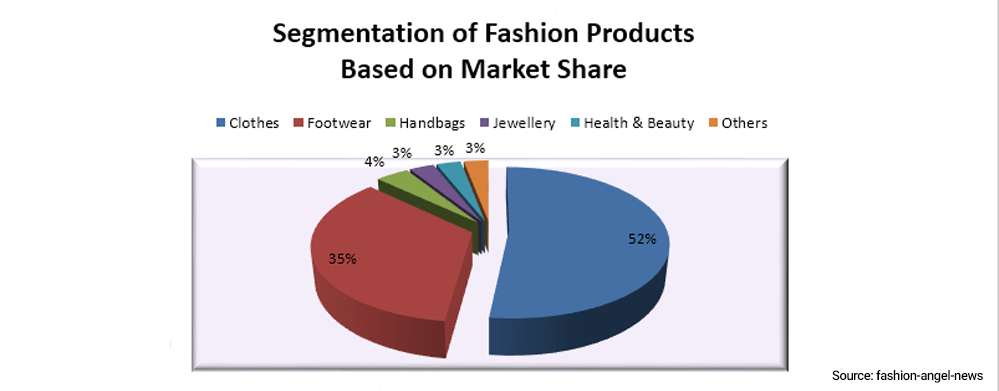
Segmentation in the Fashion Industry

In India, the division is pretty simple with mainly focusing on clothes (52%).

The Rise on Mobile Commerce

In India with the digital boom especially with Reliance Jio, consumer behavior changed to M-commerce (Mobile Commerce).

According to Google, every third query on Google is related to Fashion and this trend increases at 65% annually.

Also, 75% of mobile users say they reach a retailer website or app on their smart device to address their needs. The rise in m-commerce has definitely increased sales transactions through wireless electronic handheld devices such as mobile phones, laptops & smartphones, etc.

Audience Engagement through Content & Discounts

Successful content is anything but boring. Great content helps with customer acquisition.

Fashion eCommerce brands use a lot of social media for audience engagement.

Think “End of Season Sale” or “The Big Billion Days” or “The Independence Day Sale”.

The Big Billion Day

The traffic on these sales on websites like Amazon, Myntra, Ajio, Shein can be skyrocketing!

Look at this data here:

Diwali-festive-sales

In 2018, Flipkart sold the maximum products during the Diwali season.

Indian smartphone users most likely to buy products over the holiday season in which, electronics, fashion are the top two categories.

This discounting program has to be promoted quite carefully before the arrival and during the season through all major social media platforms like Twitter, Facebook, Instagram, Pinterest, Email marketing and also through blogging.

The total number of online transactors was 200 million in 2017 and they are expected to increase by 65% by 2020.

Recently, Myntra said the brand is witnessing a change in consumer profile.

The changing online consumer profile is evident from a significant shift in numbers, such as 50% of consumers reside in rural areas as opposed to the earlier 30%.

Some segments are seeing the surprising spike, like activewear.

According to the report by Myntra, activewear is growing at 2X of casual and formal apparel on the platform. Out of this 60% of this growth is being contributed by Tier 2+ markets.

Not only apparel, but there has also been a rise in athleisure sportswear accessories as well. Millennials over 30 years of age are driving the growth of the category & about a 4X rise in the area.

Currently the fashion market in India, according to reports in around $70Bn.

In the current shopper-centric era, the Indian fashion industry is joining hands with technological advancements. Retailers are progressively accepting innovative ideas and tactics to create a memorable and personalized shopping experience.

Branding & marketing are the two most crucial pillars of fashion e-commerce. Without proper marketing, it is impossible to make a mark in this competitive field.

So, if you own or planning to start a fashion e-commerce platform, you need a solid marketing strategy.

Want some help? Contact us at Skyram Technologies. Our experts will help you design a comprehensive marketing strategy that would be perfect for your business profile & target audience.

Also, for our other blogs on marketing read here!