

Your website does not become more authoritative because you add a text file.
That is the starting point for an honest conversation about llms.txt.
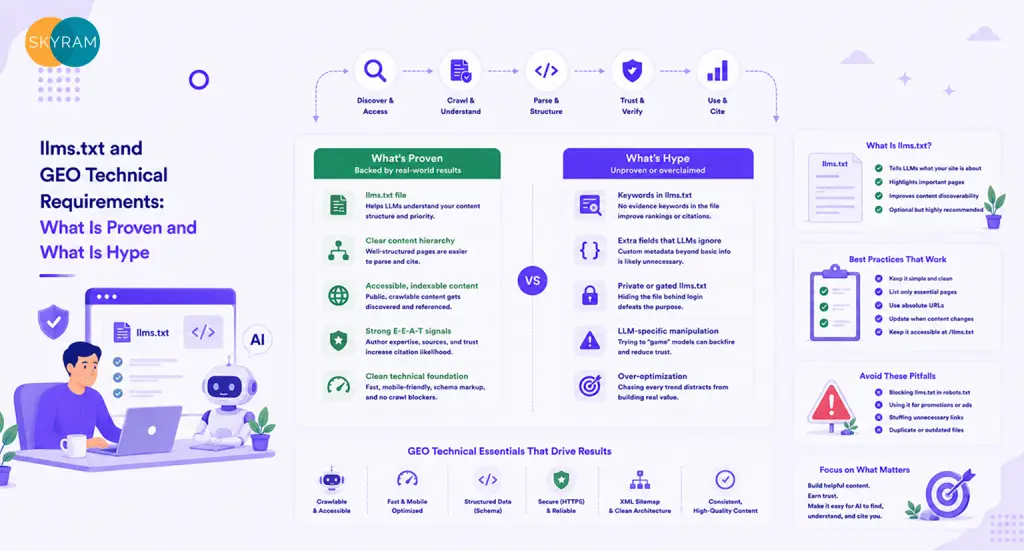
llms.txt is a proposed Markdown format that introduces a website and directs AI agents toward selected resources. It can help participating agents navigate documentation. However, it is not a universal requirement for AI search visibility. Google explicitly says it does not use llms.txt for search, including its generative AI features.
For CTOs and SEO leaders, the distinction matters. A useful documentation tool and a proven search optimization tactic are not the same thing.
An implementation might help a coding agent locate the right API reference. That is a practical outcome worth testing.
But claiming that the same implementation guarantees citations in ChatGPT, Perplexity, Gemini, or Google AI Overviews goes beyond the reviewed evidence.
The right approach is neither blind adoption nor automatic dismissal. Separate documented platform requirements from useful practices and experimental tactics.
Then allocate your engineering time accordingly.
What llms.txt Actually Does
llms.txt gives participating AI agents a concise introduction to a website and links to useful resources. Think of it as a curated reading guide rather than a complete inventory of every page.
The proposal was published by Jeremy Howard on September 3, 2024. Its current version was modified on August 10, 2026. The updated proposal supports files at the domain root and within subpaths, such as documentation directories.
This is an important detail. Many explanations still describe llms.txt exclusively as a root-level file.
Under the current proposal, a file can describe the URLs beneath its location. A software company can maintain a documentation-specific index without summarizing its entire corporate website.
A hypothetical developer platform might use the file to identify:
- Installation instructions.
- Authentication documentation.
- API reference pages.
- SDK documentation.
- Migration guides.
- Troubleshooting resources.
- Product limitations.
Short descriptions explain what each resource contains. An agent following the index can then retrieve the relevant page.
That is a navigation benefit. It is not automatically a ranking benefit.
The proposal describes how agents can use the file. It does not require every search platform to discover, read, or prioritize it.
If your team needs the broader context, Skyram’s guide to what generative engine optimization means explains the discipline. Here, the focus is narrower: which technical claims deserve a place in your implementation plan?
Different files serve different purposes.
Calling llms.txt an “AI sitemap” can make the concept easier to explain. It can also blur distinctions that matter operationally.
| Resource | Primary purpose | What it does not guarantee |
| robots.txt | Communicates crawling rules to participating bots | Indexing, rankings, citations, or protection of confidential information |
| XML sitemap | Helps search engines discover listed URLs | Indexing or ranking |
| llms.txt | Introduces selected resources to participating AI agents | Universal adoption or higher AI visibility |
| Structured data | Describes relevant page information in a machine-readable format | Automatic inclusion in AI answers |
| Markdown alternative | Provides a clean text representation of content | Preference over the original HTML page |
The llms.txt proposal distinguishes its role from robots.txt and XML sitemaps. Google separately states that special AI files and special schema markup are unnecessary for its generative search features.
The practical distinction is straightforward: discovery guidance is not access control, and successful access is not a citation.
A system can retrieve your content without recommending your company. An agent can use your documentation without increasing your visibility in public search answers. These outcomes need separate measurement.
What adoption actually proves
A company publishing llms.txt proves that the company has implemented the format. An agent using that file proves compatibility in that workflow.
Neither observation, by itself, proves that a public search platform uses llms.txt as a ranking signal.
This is where many claims become misleading. They jump from “the file exists” to “the file improves AI visibility” without demonstrating the connection.
For a CTO, that missing connection should trigger a question: what measurable problem are we solving?
Proven Requirements Versus Hype
A requirement should be tied to a named platform and a documented function. A useful practice should have a clear operational benefit. An experimental tactic should be presented as a hypothesis, not a prerequisite.
That framework makes technical GEO decisions easier to evaluate.
| Common claim | Evidence status | What your team should do |
| llms.txt is required for Google AI Overviews. | Contradicted by Google’s guidance | Do not implement it for Google eligibility. |
| llms.txt improves Google rankings | Contradicted by Google’s guidance | Do not present it as a Google ranking tactic. |
| Google AI visibility depends on search eligibility. | Documented | Check indexing, snippet eligibility, and current Search Console requirements. |
| OAI-SearchBot supports ChatGPT search discovery | Documented by OpenAI | Review crawler permissions and infrastructure access |
| GPTBot must be allowed for ChatGPT search. | Contradicted by OpenAI’s independent controls | Separate search access from training preferences. |
| PerplexityBot supports Perplexity search discovery. | Documented by Perplexity | Review robots.txt and verify bot access. |
| The special GEO schema is mandatory. | Contradicted for Google Search | Use appropriate structured data without inventing requirements. |
| llms.txt guarantees AI citations. | Not established by the reviewed documentation | Treat citation improvement as a hypothesis |
These findings reflect Google’s current guidance, OpenAI’s crawler documentation, and Perplexity’s bot documentation. They should not be generalized into guarantees across every AI product.
Google: no llms.txt visibility boost
Google’s position is direct.
Its current optimization guidance says Google Search does not use llms.txt. Creating the file for other systems is acceptable, but maintaining it neither improves nor harms Google Search rankings or visibility.
Google also distinguishes discovering a file from assigning it special significance. A file can be crawled or indexed without receiving special treatment.
That distinction prevents a common measurement mistake.
A Googlebot request in your server logs does not prove that llms.txt influenced a ranking. The file appearing in search results does not prove that Google uses it for AI optimization.
A request is evidence of access. It is not evidence of impact.
Google’s current optimization guide identifies indexed, snippet-eligible pages and inclusion in Search Generative AI features through Search Console as eligibility conditions. Teams should verify current settings rather than rely entirely on older checklists.
Eligibility still does not guarantee selection. Google states that crawling, indexing, and serving are not guaranteed.
Skyram’s explanation of GEO versus SEO explores the strategic relationship. For Google-specific technical decisions, official documentation should remain the source of truth.
OpenAI: distinguish search from training
OpenAI documents separate crawlers and user agents for different purposes.
OAI-SearchBot supports discovery for ChatGPT search. GPTBot crawls content that may be used to train foundation models. ChatGPT-User supports certain user-initiated actions.
These controls are independent.
A website can allow OAI-SearchBot while disallowing GPTBot. OpenAI explicitly documents this combination. Allowing training access is not a prerequisite for permitting ChatGPT search crawling.
That distinction matters for governance.
An SEO team may want search visibility. A legal or security team may prefer to restrict training access. Those preferences can be evaluated separately rather than treated as one decision.
The reviewed OpenAI crawler documentation does not identify llms.txt as a requirement for ChatGPT search inclusion. It instead documents bot-specific robots.txt controls and published IP ranges.
The defensible conclusion is limited but useful: llms.txt is not an established ChatGPT search prerequisite in that documentation.
That is different from claiming no OpenAI product or agent could ever use the file.
Perplexity: access is documented.
PerplexityBot is designed to surface and link websites in Perplexity search results. Perplexity recommends allowing it in robots.txt and permitting requests from its published IP ranges.
Perplexity also documents a separate user-triggered fetcher, Perplexity-User. Its purpose differs from automated search crawling.
Interestingly, Perplexity’s documentation offers an llms.txt index to help agents discover documentation pages. That is a real example of the format serving a navigation purpose.
It is not proof that websites publishing llms.txt receive preferential treatment in Perplexity answers.
Both statements can be true: the format can be useful, and a universal citation benefit can remain unproven.
Technical Work Worth Prioritizing
Before implementing an optional file, check whether your important content is accessible, discoverable, consistent, and useful.
Google recommends crawlable content, internal discovery paths, good page experience, and important information available in text. OpenAI and Perplexity document their respective search crawler controls.
These foundations deserve priority because they address known conditions, not speculative advantages.
Verify access across your infrastructure.
robots.txt is only one part of the delivery path.
A page may be permitted by robots.txt while a firewall presents a challenge. A CDN may block a legitimate crawler. A hosting rule may return an error.
Google recommends checking CDN and hosting access alongside robots.txt. Perplexity provides firewall guidance using user-agent matching and IP verification.
For priority public pages, examine:
- Whether requests return the intended content.
- Whether robots.txt matches your search and training policies.
- Whether verified bot requests pass through the firewall.
- Whether redirects reach the correct destination.
- Whether essential information requires authentication.
- Whether recent infrastructure changes altered access.
Do not disable security controls indiscriminately.
Where a platform provides verification information, use it. Perplexity recommends combining user-agent checks with its current official IP ranges rather than trusting the user-agent alone.
Skyram’s guide to the technical SEO foundation for AEO provides a related starting point. Apply it while keeping search crawlers, training crawlers, and user-triggered fetchers distinct.
Confirm eligibility and consistency
For Google’s generative Search features, indexed and snippet-eligible content remains essential. The current optimization guide also identifies Search Console inclusion as an eligibility condition.
Publishing a page does not confirm that it meets those conditions.
Review the preferred URL, indexing status, canonical configuration, and applicable preview controls. Resolve accidental exclusions before adding another machine-readable resource.
Duplicate content also deserves attention. Google recommends reducing duplicates because they can hurt usability and consume crawling resources unnecessarily.
Consider a hypothetical SaaS company with three authentication guides. The navigation points to one. A blog links to another. llms.txt points to the oldest version.
The problem is not the absence of an AI file. It is the absence of a consistent source of truth. Fix the underlying documentation and align the discovery paths. Otherwise, the new file can make outdated information easier to find.
Make essential information readable
Google can process JavaScript, but its guidance acknowledges additional SEO complexity on JavaScript-based websites. It recommends following JavaScript SEO best practices.
Avoid blanket claims.
Do not assume every AI crawler renders an application exactly like a browser. Do not assume all JavaScript content is invisible.
Test how important information is delivered.
For a US software business, priority information might include:
- Pricing conditions and billing terms.
- Supported integrations.
- Deployment requirements.
- Product limitations.
- Security documentation.
- Migration instructions.
- Support availability.
Readers should not need several interactions to discover a basic limitation or requirement.
This is where AI content optimization should stay grounded in usability. Improve access and clarity without claiming that one formatting pattern unlocks every platform.
Use structured data accurately.
Structured data can describe relevant information about an organization, article, product, or other page type.
However, Google explicitly says structured data is not required for generative AI search. It does not require special schema.org markup for these features.
Prioritize accuracy over novelty.
Use appropriate types where they support relevant search features. Ensure the markup reflects visible content. Correct misleading information and implementation errors.
Do not sell FAQPage, article, or organization markup as a universal AI citation gate.
A successful validation result confirms something about the implementation. It does not certify that an AI platform will cite the page.
Publish information worth retrieving
Technical access creates an opportunity for consideration. It does not make the content valuable.
Google’s current guidance emphasizes unique viewpoints, firsthand knowledge, and non-commodity content. It also states there is no requirement to divide content into tiny chunks or follow an ideal page length.
For a CTO audience, useful content might include a migration checklist, a reproducible benchmark, or a troubleshooting guide explaining failure conditions.
For an SEO audience, it might include a transparent audit methodology or a documented comparison of platform requirements.
These are editorial opportunities, not guaranteed ranking factors.
Similarly, concise answer blocks can improve readability. A particular word count should not be presented as a platform requirement without evidence.
External coverage is a separate workstream. Skyram’s article on digital PR for AEO and GEO explores that approach.
Keep it authentic. Google specifically warns against seeking inauthentic mentions as a generative search tactic.
When llms.txt Makes Sense
llms.txt deserves investment when a defined workflow can use it and someone can maintain it.
Software documentation is a clear use case in the proposal. It describes agents navigating API references and tutorials through selected resource links.
For a documentation-heavy company, the strongest business case may be operational rather than promotional.
A coding agent could locate the correct setup guide. An internal assistant could navigate approved resources. A customer could direct an agent to a maintained documentation index.
Those outcomes can be evaluated.
For a small corporate website, the case may be less compelling. If the important pages are easy to find and no workflow consumes the file, the maintenance cost may outweigh the immediate benefit.
Build around a defined scope.
Start by deciding what the file covers.
Does it introduce the whole website? Does it serve an API documentation directory? Does a particular agent workflow require it?
The current proposal supports subpath files for narrower sections. It also describes discovery relationships for the index and Markdown alternatives. These are recommendations within the proposal, not Google Search requirements.
Create a concise introduction and resource list. Use informative descriptions rather than promotional language.
Before publishing, review each destination:
- Does the link text accurately describe the resource?
- Is the information current?
- Does the destination fulfill the description?
- Is there a competing version?
- Is the resource intended for public access?
- Who owns future updates?
The proposal requires an H1 identifying the project or site and provides guidance for additional descriptions and categorized resource lists.
Where you offer Markdown alternatives, keep them consistent with the source pages. A cleaner representation that omits a limitation is not better documentation. It creates another version of the truth.
Measure the right outcome.
Documentation performance and public search visibility require separate tests.
For documentation, select representative tasks. Compare an agent’s performance with and without the llms.txt-assisted workflow.
Evaluate factual accuracy, successful resource discovery, broken references, and task completion. Measure time and cost where practical. For public AI visibility, establish a separate baseline.
Use a stable set of relevant prompts. Record the platform, date, mode, cited URLs, and whether the brand is mentioned or linked.
Repeat the observations. One favorable answer is not enough to demonstrate a durable benefit. Attribution also matters.
If you change your content, internal links, firewall configuration, and llms.txt simultaneously, you cannot confidently assign a later improvement to the file.
Experimentation is valuable when it answers a defined question. It is less useful when every favorable result becomes proof of the preferred explanation.
Skyram’s guide to evaluating a GEO agency offers a related procurement framework.
For technical buyers, ask: “Which documented requirement or measurable hypothesis does this deliverable address?”
Use a three-lane roadmap
| Workstream | Typical actions | Appropriate measurement |
| Platform eligibility | Review indexing, Search Console settings, crawler controls, and infrastructure access. | Confirmed eligibility and successful access |
| Content quality | Resolve contradictions, improve discovery, and publish useful evidence. | Accuracy, usability, engagement, and relevant visibility |
| Optional experiments | Test llms.txt, Markdown alternatives, and agent navigation. | Measured task improvements or repeatable observed outcomes |
This approach makes ownership clearer.
Engineering manages delivery, permissions, and reliability. SEO manages discovery, eligibility checks, and search measurement. Content teams maintain accuracy and usefulness.
Skyram Technologies’ generative engine optimization services describe technical audits, content architecture, and visibility monitoring. Those capabilities are most useful when applied to a prioritized diagnosis, not framed as a promise that one file will secure citations.
The decision rule is simple: implement llms.txt when it supports a real workflow. Defer it when more consequential access, accuracy, or discovery problems remain unresolved.
Frequently Asked Questions
What is llms.txt?
llms.txt is a proposed Markdown file that introduces a website and links to selected resources for participating AI agents. It supports navigation and context. It does not replace robots.txt, an XML sitemap, or normal website content.
Does llms.txt improve SEO?
Google explicitly says llms.txt neither improves nor harms Google Search rankings or visibility. That statement includes its generative AI capabilities. Benefits for other agent workflows should be evaluated separately rather than described as a proven SEO boost.
Is llms.txt required for Google AI Overviews?
No. Google does not use llms.txt for Search or its generative AI features. Its guidance instead identifies Search eligibility conditions, including indexing, snippet eligibility, and relevant Search Console settings. Meeting those conditions does not guarantee inclusion.
Do ChatGPT and Perplexity require llms.txt?
The reviewed crawler documentation does not identify llms.txt as a search inclusion requirement. OpenAI documents OAI-SearchBot controls, while Perplexity documents PerplexityBot access. A documentation index and a public search citation mechanism are different things.
Where should an llms.txt file go?
The current proposal allows llms.txt at the website root or within a subpath, such as a documentation directory. A file describes URLs beneath its location. More specific files can guide agents within narrower website sections.
Is llms.txt the same as robots.txt?
No. robots.txt communicates crawling rules to participating automated tools. llms.txt provides contextual information and selected resource links. It does not replace crawler permissions, authentication, security controls, or platform-specific settings used to manage search access.
Should I allow GPTBot for ChatGPT search visibility?
Allowing GPTBot is not required to permit ChatGPT search crawling. OpenAI documents independent controls for GPTBot and OAI-SearchBot. A website can allow search discovery while disallowing crawling that may support foundation-model training.
Does GEO require special schema markup?
Google says its generative search features do not require special schema.org markup or structured data. Use appropriate markup accurately where relevant, but do not treat schema implementation as a universal requirement for citations across AI platforms.
Can llms.txt guarantee AI citations?
No citation guarantee is established by the reviewed official documentation. llms.txt can guide participating agents toward resources, but discovery does not guarantee selection. Measure documentation usefulness and public search outcomes separately before attributing improvements to the file.