

Your traffic analytics changed sometime in the past twelve months. Pages that ranked steadily for years started dropping. Some lost featured snippets to AI Overviews. Others got absorbed into generative summaries without any click through to your site. The culprit is not a Google algorithm update in the traditional sense. It is a structural shift in how search engines consume, evaluate, and surface content.
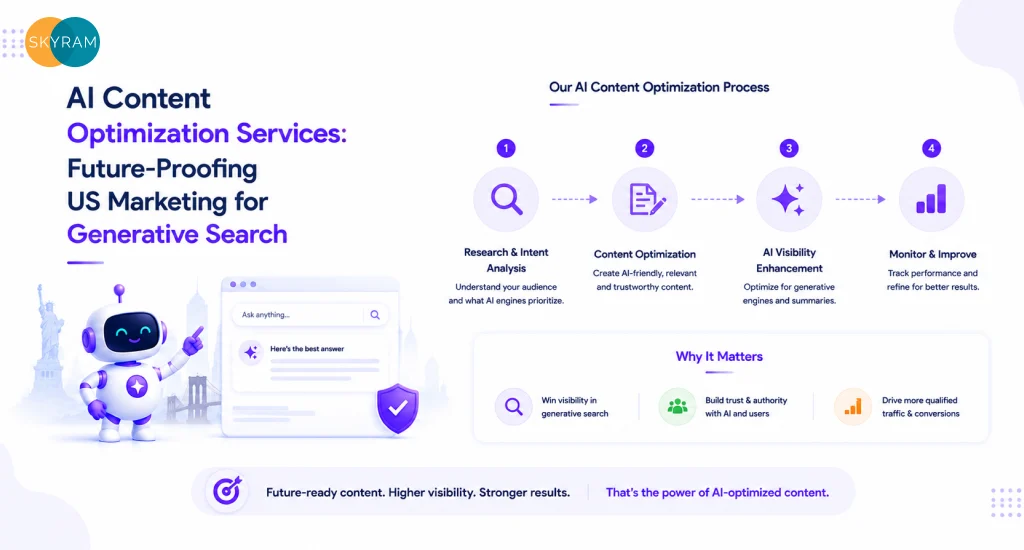
AI content optimization services exist to address exactly this problem. They reformat, restructure, and re-signal your content so that both human readers and large language models can extract, trust, and cite it. For US content managers and CMOs watching organic traffic metrics flatten, this is where the strategic response starts.
What AI Content Optimization Actually Means in 2026
The term gets used loosely, so a precise definition matters. AI content optimization is the practice of structuring and signaling digital content so that AI-powered search systems, including Google’s AI Overviews, Bing Copilot, and retrieval-augmented generation (RAG) models, can accurately parse, summarize, and attribute it.
This is meaningfully different from traditional SEO. Traditional SEO optimized for crawlers that scored signals like keyword frequency, backlink authority, and on-page structure. Generative search engines work differently. They ingest content to understand it at a semantic level, identify source credibility, and decide whether a page is worth citing in a generated answer or surfacing directly.
Three Core Layers of AI Content Optimization
Effective optimization works across three distinct layers:
- Semantic structure: Using clear definitional paragraphs, consistent entity references, and schema markup so AI models can map your content to specific topics and queries.
- Answer-first formatting: Placing direct answers within the first 40 to 60 words of a section so that AI extraction picks up the response before context degrades.
- Authority signaling: Using author attribution, citation links, and factual specificity to score high on the E-E-A-T signals that generative models use to determine source trustworthiness.
Brands that treat these as optional upgrades are already ceding ground to competitors who treat them as baseline requirements.
| Key Takeaway: AI content optimization is not an extension of traditional SEO. It is a distinct practice focused on making content legible and credible to generative search systems. Ignoring the structural differences between these two approaches will produce content that ranks for neither humans nor machines effectively. |
Why US Brands Need AI Content Optimization Services Now
US search behavior is shifting faster than most marketing teams have acknowledged internally. According to data from SparkToro and Semrush published in 2024, zero-click searches now account for more than 60% of Google searches in the United States. A significant and growing share of those zero-click outcomes arrive because an AI Overview or featured snippet answered the query without the user needing to visit any website.
For B2B companies, this means the top-of-funnel content pipeline that drove awareness and lead entry points now faces a structural disruption. A well-optimized pillar post that once pulled 3,000 monthly visits may now generate a fraction of that because the AI Overview pulls the answer directly and the user never clicks.
The B2B Stakes Are Higher Than They Look
Enterprise buyers in the US increasingly start product and vendor research through AI-assisted search. They ask a question. They get a synthesized answer that references two or three authoritative sources. If your brand is not one of those cited sources, you are invisible at exactly the moment the buyer is forming their initial shortlist.
Vendors who invest in AI content optimization services and USA-focused strategies right now have a compounding advantage. The models that generate AI Overviews pull from indexed content that already exists. Getting your content into that citation pool before competitors do is a timing advantage that is genuinely difficult to reverse later.
| Key Takeaway: The US search landscape is not trending toward AI-influenced results. It has already arrived. Content teams that have not restructured their assets for generative search are losing top-of-funnel visibility right now, not at some future inflection point. |
Core Components of a High-Performance AI Content Optimization Strategy
The brands getting cited in AI Overviews share specific structural and technical characteristics across their content. These are not random. They reflect how large language models are trained to identify credible, extractable answers.
Generative Engine Optimization (GEO)
GEO is the practice of optimizing content specifically for AI-driven search engines rather than traditional blue-link results. The key signals include entity density (how clearly and frequently your content references named concepts, organizations, and products), source consistency (whether your content contradicts itself or other credible sources), and structural predictability (whether AI models can identify the question-answer pattern reliably within each section).
A GEO-optimized page answers a question within the opening sentence of each key section. It does not bury the answer after three paragraphs of context. That structural discipline is what separates content that gets cited from content that gets skipped.
Answer Engine Optimization (AEO)
AEO focuses on the voice search and direct-answer use cases where the AI system needs to surface a single, authoritative response. For B2B content, AEO-optimized sections are self-contained: they define the term, explain its significance, and quantify the impact without requiring the reader or the AI model to pull context from another section.
FAQ sections built for AEO follow a strict pattern: each question mirrors the exact phrasing a user would type or speak, and each answer is complete in 40 to 80 words without referencing content elsewhere on the page.
Schema Markup and Structured Data
JSON-LD schema remains one of the highest-impact technical signals available. FAQPage schema, HowTo schema, and Article schema with author and publisher markup tell search systems what type of content they are processing before they parse a single sentence. Pages without schema make AI models work harder to classify content correctly, and that extra uncertainty often means the content gets deprioritized.
Content Depth Calibration
Depth means specific, not long. A 1,200-word article that answers a question with named examples, quantified outcomes, and clear methodology beats a 3,500-word post that circles the same ideas repeatedly. AI models score specificity. Vague language, hedged claims, and unsupported generalizations all depress the likelihood that content gets cited.
| Key Takeaway: A strong AI content optimization strategy integrates GEO, AEO, structured data, and content depth calibration as a unified system. Optimizing only one layer while ignoring others leaves measurable gaps in search visibility that compound over time. |
How AI Content Optimization Services Differ Across Providers
Not every provider offering AI content optimization delivers the same scope or methodology. The differences matter for budget allocation and expected outcomes.
Audit-Only vs. Full-Service Optimization
Audit-only providers diagnose gaps: missing schema, thin content, poor semantic structure, keyword cannibalization. They produce recommendations but leave execution to your internal team. Full-service providers audit, rewrite, restructure, and implement, then track performance against defined metrics. For teams that lack the bandwidth or technical depth to execute complex structural changes at scale, audit-only rarely moves the needle.
AI-Assisted Content Production
Some providers use AI writing tools to generate first drafts at high volume, then apply optimization frameworks before delivery. Others treat AI as a research and analysis tool while keeping the actual writing human. Neither model is categorically superior. The quality of the prompt engineering, editorial oversight, and post-generation optimization determines output quality, not the presence or absence of AI in the production pipeline.
Technical SEO Integration
Content optimization without technical SEO integration consistently underperforms. Page speed, Core Web Vitals, mobile usability, and crawl accessibility all affect whether your optimized content gets indexed correctly. Providers who treat content and technical SEO as separate workstreams tend to create situations where beautifully structured content sits behind crawl barriers or loads too slowly to rank.
| Key Takeaway: Provider selection for AI content optimization services should prioritize full-service execution, transparent methodology, and integrated technical SEO support. Providers who operate in isolation from technical teams or who rely entirely on AI-generated output without editorial rigor will produce inconsistent results. |
Building an AI-Ready Content Architecture from Scratch
US marketing teams who are starting from zero with generative search optimization face a sequencing challenge. Everything cannot happen at once, and the wrong sequencing wastes budget on content that cannot perform until foundational issues get fixed.
Phase 1: Technical Baseline
Before restructuring any content, confirm that your site can be indexed accurately. Run a crawl audit. Fix redirect chains, broken internal links, and canonicalization errors. Verify that Core Web Vitals meet current thresholds across both desktop and mobile. Schema implementation starts here too: site-level Organization and WebSite schema, then page-level markup as content gets optimized.
Phase 2: Keyword Cluster Prioritization
Not all keyword clusters have equal potential in generative search. Informational queries with clear answer structures get featured in AI Overviews far more often than navigational or commercial queries. Map your existing content against informational intent first. These pages represent the fastest path to AI Overview citations and the strongest return on initial optimization investment.
Phase 3: Content Restructuring
Each priority page gets restructured using the GEO and AEO principles described above. This means rewriting opening paragraphs to lead with answers, adding structured FAQ sections, implementing schema, and tightening entity references throughout. For long-form pillar posts, this often means splitting one sprawling article into a tightly organized pillar plus multiple supporting cluster posts that each answer a specific question with depth.
Phase 4: New Content Production
Once the existing archive is optimized and indexed, new content production scales up against the remaining keyword targets. Each new post gets built to the optimized standard from the first draft rather than needing a retroactive fix. This phase is where volume compounds: a strong technical and structural foundation means each new post starts with a higher baseline probability of getting cited.
| Key Takeaway: AI-ready content architecture is a phased investment, not a one-time project. Teams that try to skip the technical baseline phase and go straight to content production end up republishing optimized content on a foundation that limits its indexing and citation potential. |
Measuring the ROI of AI Content Optimization
ROI measurement for AI content optimization services requires different metrics than traditional SEO tracking. Click-through rates and raw organic traffic tell only part of the story when a growing share of search value comes from brand citations in AI Overviews rather than direct clicks.
Metrics That Matter Now
- AI Overview citation frequency: Track how often your brand or specific pages appear as cited sources in AI Overviews for target queries. Tools like BrightEdge and SE Ranking have added AI Overview tracking to their reporting suites.
- Share of voice in generative results: Monitor what percentage of relevant AI-generated answers in your category reference your content versus competitor content.
- Branded search lift: As your content gets cited more frequently in AI Overviews, expect measurable increases in branded search queries. Users who see your brand attributed as a source often follow up with a direct branded search.
- Lead quality and conversion rate from organic: If content is properly structured for TOFU and MOFU intent, leads arriving from organic should convert at higher rates than before because they arrive with more contextual knowledge about your solution.
Do not abandon traditional metrics entirely. Keyword rankings, organic sessions, and bounce rate still provide useful diagnostic signals. The goal is to build a reporting framework that captures both traditional search performance and emerging generative search visibility.
| Key Takeaway: ROI measurement for AI content optimization must expand beyond clicks and rankings to include AI Overview citation tracking and branded search lift. Teams that evaluate this investment using only traditional SEO metrics will systematically undercount the value being generated. |
Frequently Asked Questions
1. What are AI content optimization services?
AI content optimization services are professional services that restructure, reformat, and re-signal website content to improve its visibility and citation frequency in AI-powered search results, including Google AI Overviews, Bing Copilot, and answer engine interfaces. The work typically includes semantic restructuring, schema implementation, FAQ optimization, and content depth calibration to make content legible and credible to large language models.
2. How do AI content optimization services differ from traditional SEO?
Traditional SEO optimizes content for crawler-based ranking algorithms that score signals like keyword frequency, backlink volume, and page authority. AI content optimization targets generative search systems that process content semantically, assessing whether it contains complete, credible, and extractable answers to user queries. The structural requirements are different: generative search rewards answer-first formatting, entity clarity, and source credibility signals that traditional SEO does not prioritize in the same way.
3. Which US industries benefit most from AI content optimization services?
B2B technology, professional services, healthcare, financial services, and legal sectors see the highest lift from AI content optimization because their buyers conduct extensive research through AI-assisted search before contacting vendors. These industries also have high-value long-tail queries with clear informational intent, which are exactly the query types that AI Overviews favor. However, any sector where buyers research online before converting benefits from this approach.
4. How long does it take to see results from AI content optimization?
Structural changes to existing content can produce AI Overview citation improvements within four to eight weeks for pages that are already indexed and receiving some organic traffic. New content built to the optimized standard typically takes eight to sixteen weeks to accumulate the crawl frequency and index depth needed for consistent AI Overview citations. Technical SEO fixes like schema implementation and Core Web Vitals improvements tend to produce faster indexing gains that accelerate subsequent content performance.
5. What is the role of AEO in AI content optimization?
Answer Engine Optimization (AEO) is the specific practice of structuring content to perform in direct-answer and voice search interfaces where AI systems need to surface a single, concise, authoritative response. Within a broader AI content optimization strategy, AEO handles FAQ architecture, definitional paragraph construction, and the answer-first formatting that makes content extractable by AI Overviews. It works alongside GEO, which targets AI-driven search engines more broadly, and traditional SEO, which addresses crawler-based ranking signals.
6. Do I need to replace all my existing content to benefit from AI content optimization services?
No. A strategic audit identifies which existing pages have the highest potential for AI Overview citations based on current traffic, keyword intent, and structural gaps. High-potential pages get restructured and enhanced rather than replaced. Thin or duplicate pages may get consolidated or retired. Completely new content is only justified for keyword clusters where no existing asset can be cost-effectively upgraded. The most efficient approach layers optimization across existing high-value content first before scaling new production.
7. How do AI content optimization services usa providers handle schema implementation?
Reputable providers implement schema at two levels: site-wide organizational markup that establishes brand identity and publisher authority, and page-level schema that classifies each content type accurately, including Article, FAQPage, HowTo, and Product schemas where relevant. Schema gets added via JSON-LD in the page head, validated against Google’s Rich Results Test, and monitored through Search Console for errors. For enterprise sites, schema implementation typically connects to the CMS templating layer so new pages inherit correct markup automatically.
Ready to Make Your Content Visible to Generative Search?
The gap between brands that appear in AI Overviews and those that do not will widen over the next eighteen months. Content that is not structured for generative search will continue losing share of voice to competitors who invested in the right optimization framework earlier.
Skyram Technologies works with US marketing teams to audit existing content, implement GEO and AEO frameworks, and build scalable production systems that generate AI-ready content from the first draft. The process is diagnostic first: we identify exactly which pages have the highest citation potential and what structural changes would activate that potential fastest.
Start with a content audit or explore our AEO services to understand how your content performs against generative search benchmarks. Contact Skyram Technologies to schedule a consultation with our content strategy team.
| Talk to Skyram Technologies about AI content optimization for your US marketing strategy. No templates, no generic audits, just a structured assessment of where your content stands and what it takes to get cited. |