

Your website is live. Your product is solid. But when a potential customer types exactly what you sell into Google, your competitors show up and you do not. That is not a brand problem or a product problem. That is an organic visibility problem, and it is more common than most business owners want to admit.
Search engine optimization services exist precisely to fix this. Done properly, SEO turns a website that Google ignores into one that earns qualified traffic every single day without paying for each click. But the phrase search engine optimization services covers a wide range of activities, providers, and outcomes, and most buyers enter this market with too little context to separate what works from what sounds good in a sales pitch.
This guide gives you that context. By the end, you will understand what SEO services actually include, how they work in 2026, what makes a provider worth hiring, and how to build an organic growth program that produces real commercial results for your US business.
What Search Engine Optimization Services Actually Include
Ask ten different agencies what SEO services include and you will get ten different answers. Most of them are right, but they describe different layers of the same discipline. SEO is not one activity. It is a system of interconnected activities that, together, determine how well a page ranks for the queries that matter to your business.
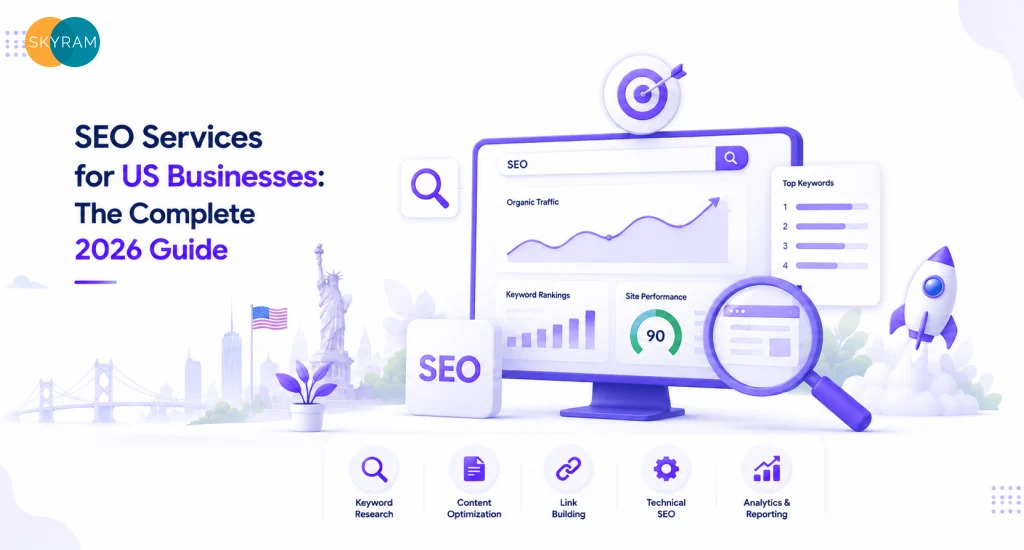
Here is what a complete engagement covers:
Technical SEO
This is the foundation everything else sits on. Technical SEO addresses how Google crawls, indexes, and interprets your site. If Google cannot efficiently access your pages, your content and backlinks will not produce the rankings you expect.
Key areas include:
- Site architecture and internal linking structure
- Crawl budget management, especially relevant for large sites or low-authority domains
- Core Web Vitals: Largest Contentful Paint, Interaction to Next Paint, Cumulative Layout Shift
- Canonical tags, hreflang, and duplicate content resolution
- Schema markup and structured data implementation
- XML sitemap health and robots.txt configuration
On-Page SEO and Content Optimization
On-page SEO covers everything that happens within the page itself. That includes title tags, meta descriptions, heading hierarchy, keyword placement, internal links, and content structure. But in 2026, good on-page SEO also means writing content that satisfies search intent, not just content that contains the right keywords.
Google has shifted heavily toward understanding what a user actually wants from a query. A page that answers a question thoroughly, in the right format, for the right audience, outperforms a page that simply repeats a keyword fifteen times.
Authority Building and Link Acquisition
Backlinks remain one of the strongest ranking signals Google uses. An authority-building program earns links from credible, relevant websites by creating content other sites want to reference, developing relationships with publishers and journalists, and pursuing digital PR opportunities.
Not all links are equal. A single link from a trusted industry publication outweighs dozens of links from low-quality directories. Any provider still pitching link quantity over link quality is selling you an approach that carries meaningful risk.
Local and National SEO for US Markets
US businesses serving local markets need a different strategy than businesses targeting national audiences. Local SEO focuses on Google Business Profile optimization, local citations, review acquisition, and proximity-based ranking signals. National SEO focuses on topical authority, domain-wide keyword coverage, and competing for informational and transactional queries at scale.
Most small and mid-sized businesses need a blend of both, weighted toward their actual service geography.
Analytics, Reporting, and Continuous Optimization
SEO without measurement is just publishing. A proper engagement includes setting up accurate tracking through Google Search Console and GA4, defining KPIs tied to business outcomes (not just keyword positions), and running a monthly cycle of review, hypothesis, and implementation. Rankings change. Content ages. Competitors invest. The optimization cycle never really ends.
| Key Takeaway: Search engine optimization services span five interconnected layers: technical infrastructure, on-page content, authority acquisition, market-specific strategy, and analytics. Buying any single layer without the others produces diminishing returns. Effective SEO programs address all five as a coordinated system. |
How Google Actually Ranks Pages in 2026
Understanding Google’s ranking logic in 2026 matters because it directly shapes what SEO services should prioritize for your site. The algorithm has changed significantly over the past three years, and some widely held beliefs about SEO are no longer accurate.
The Role of Helpful Content
Google’s Helpful Content system, which began rolling out in 2022 and matured through 2024 and 2025, evaluates whether content was created primarily to serve people or primarily to rank. Sites that publish large volumes of thin, templated, or AI-generated content that adds no real insight have lost rankings significantly under these updates.
Helpful content, by Google’s definition, demonstrates first-hand experience, genuine expertise, and satisfies the user fully enough that they do not return to search results looking for a better answer. That is a high bar, and it is the bar your content operation needs to clear.
E-E-A-T: Experience, Expertise, Authoritativeness, Trustworthiness
E-E-A-T is not an algorithm but a framework Google’s quality raters use to evaluate content quality. It informs the training of ranking systems. For US businesses, this means your site needs demonstrable signals of expertise: real author profiles, accurate business information, legitimate third-party references, and content that reflects actual knowledge of the subject matter.
A company blog with no author bylines, no about page, and no external references earns very little E-E-A-T credit, regardless of how well the posts are optimized for keywords.
AI Overviews and Search Generative Experience
Google AI Overviews now appear above organic results for a significant share of queries, particularly informational ones. This changes the traffic math for some keyword types. Pages that appear as sources inside AI Overviews can still receive meaningful traffic, but the click-through dynamic is different from traditional blue links.
Answer Engine Optimization (AEO) addresses this directly. Structuring content with standalone definitional paragraphs, direct FAQ-format answers, and schema markup increases the probability your content gets cited in AI-generated responses. Agencies serious about 2026 SEO build AEO practices into every content deliverable.
Core Web Vitals Remain a Ranking Factor
Google confirmed that Core Web Vitals remain part of its Page Experience signal. Interaction to Next Paint (INP), which replaced First Input Delay in March 2024, now measures all user interactions rather than just the first one. Sites with poor INP scores, particularly those running heavy JavaScript frameworks or legacy WordPress themes with unoptimized plugins, face a real ranking disadvantage in competitive verticals.
| Key Takeaway: Google in 2026 rewards content that demonstrates genuine expertise, satisfies user intent completely, and loads fast. SEO services that do not account for Helpful Content guidelines, E-E-A-T signals, and AI Overview optimization are working with an outdated model. Ask any prospective provider how they address each of these specifically. |
The Three Ways US Businesses Source SEO Services (and How to Choose)
US businesses pursuing organic growth generally have three options: build an in-house SEO team, hire a freelance specialist, or work with an agency. Each model has legitimate use cases. The right choice depends on your business size, competitive landscape, budget, and internal capabilities.
| Factor | In-House SEO | Freelance SEO | SEO Agency |
| Skillset breadth | Depends on hire | Single specialty | Full team coverage |
| Speed to launch | Slow (hire/onboard) | Fast | Fast |
| Tool access | Self-funded | Limited | Enterprise-grade |
| Scalability | Restricted | Low | High |
| Accountability | Internal | Varies | Contractual SLAs |
| Cost efficiency | High fixed cost | Low, limited scope | Best ROI at scale |
When In-House SEO Makes Sense
Building an internal team makes sense when you have enough SEO scope to justify multiple full-time roles, when your competitive environment requires proprietary strategy that you want to keep internal, or when you are in a regulated industry where outside partners face access restrictions. Most US businesses below the enterprise tier do not hit these thresholds. A single in-house SEO manager without supporting specialists in technical SEO, content, and link acquisition is typically under-resourced for anything beyond baseline optimization.
When Freelance SEO Works
Freelancers make sense for narrow, well-defined scopes: a one-time technical audit, a content refresh for a specific page cluster, or keyword research for a new product launch. They rarely make sense as a long-term growth partner because most individual practitioners specialize in one or two areas of SEO, not all five layers outlined earlier.
When to Work With an SEO Agency
An agency provides access to a full team: technical specialists, content strategists, outreach professionals, and data analysts, without the fixed overhead of hiring each role internally. For most US SMBs and growth-stage companies, this model delivers the best return on SEO investment. The key is choosing an agency with a documented process, transparent reporting, and a track record in your vertical or competitive tier.
| Key Takeaway: Most US businesses get the most value from an agency model, which provides full-spectrum SEO expertise without the overhead of building an internal team. Freelancers fill specific gaps well but rarely cover the full scope a sustained ranking campaign requires. |
What SEO Services in the USA Cost in 2026 (and What That Actually Buys)
Pricing is one of the most opaque aspects of SEO. The range is genuinely wide. Monthly retainers for quality SEO services in the USA typically run from $1,500 per month for small businesses with limited competition to $10,000 or more per month for enterprise programs targeting competitive national verticals.
Why the Price Range Is So Wide
SEO pricing reflects scope, competition level, content volume, and team experience. A healthcare company competing for high-intent medical queries in a major metro faces a fundamentally different challenge than a niche B2B software company targeting long-tail queries with low keyword difficulty. The work required is simply not comparable, and neither is the pricing.
Low-cost SEO engagements in the $300-$700 per month range do exist. They almost uniformly involve templated deliverables, low content volume, and link acquisition practices that carry algorithmic risk. The short-term savings rarely survive a Google algorithm update.
How to Evaluate Price Against Value
Instead of anchoring on the monthly number, ask what specific deliverables you receive each month and how those deliverables connect to ranking movement and traffic growth. Legitimate SEO services produce measurable outputs: pages optimized, content pieces published, links acquired from named domains, technical issues resolved. If a provider cannot tell you exactly what you are buying each month, that is a signal to keep looking.
Contracts and Commitment Periods
SEO produces compounding returns over time, not instant results. Realistic timeframes for meaningful ranking movement are three to six months for low-competition keywords and six to twelve months for competitive terms. Agencies that promise first-page rankings in thirty days are either targeting negligible-volume keywords or making claims they cannot support. Most credible agencies work on six or twelve-month agreements because that timeframe aligns with the realistic pace of organic growth.
| Key Takeaway: Budget for SEO based on the competitive intensity of your keyword targets, not on what feels comfortable. The difference between a $2,000 per month and a $500 per month engagement is not just service volume, it is access to strategic depth, content quality, and link-building resources that directly determine how quickly you rank. |
How to Evaluate an SEO Provider Before You Sign
Most SEO providers look similar at the proposal stage. The differentiators show up in the process details, the quality of their questions, and the specificity of their reporting. Here is a reliable evaluation framework for US business owners who do not want to spend six months learning they hired the wrong team.
Ask About Their Technical SEO Process
A serious SEO provider conducts a comprehensive technical audit before recommending any strategy. Ask them to walk you through what their audit covers, how they prioritize issues, and how they handle implementation when your development resources are limited. Vague answers suggest they rely on automated tools without the technical depth to interpret or act on the findings.
Review Their Content Approach
Content is where most SEO programs either win or stall. Ask specifically how they approach content briefs, whether they match content type to search intent (not just keyword volume), and how they measure content performance after publication. Providers who treat all content as blog posts, regardless of what the SERP shows, are not doing intent-based optimization.
Understand Their Link Acquisition Philosophy
This is where the risk lives. Ask for a description of their link-building methods and examples of placements they have earned for similar clients. Acceptable answers include content-led outreach, digital PR, and resource-based link acquisition. Unacceptable answers include anything involving link exchanges, private blog networks, or paid placements without disclosure.
Ask About Reporting Cadence and Metrics
Find out exactly what you will see in monthly reports and how they connect reporting metrics to your business objectives. Ranking position is a useful leading indicator, but organic traffic trends, click-through rates, and goal completions in GA4 are what translate to actual business outcomes. If reporting stops at keyword rankings, you will not have the visibility you need to make strategic decisions.
You can review how a structured digital marketing engagement is built by exploring Skyram’s digital marketing services, which provides context on how SEO integrates with paid search, social, and content within a broader growth program.
| Key Takeaway: The best way to evaluate an SEO provider is to pressure-test their process, not their pitch deck. A provider with a clear technical methodology, intent-driven content approach, and transparent link acquisition practices is worth paying more for than one with a polished proposal and vague answers. |
Building a Keyword Strategy That Drives Revenue, Not Just Traffic
Traffic volume is a vanity metric if the visitors have no commercial intent. A keyword strategy aligned to revenue targets starts with understanding the full funnel of queries your prospects use as they move from awareness to purchase.
Mapping Keywords to Funnel Stage
Top-of-funnel keywords capture users in research mode. These are informational queries with broad intent and high search volume. They build brand awareness and topical authority but convert slowly. Bottom-of-funnel keywords capture users who are close to a buying decision. These have lower volume but far higher conversion rates. A healthy SEO program targets both.
Examples in the B2B tech space: a top-of-funnel query might be ‘what is cloud infrastructure management?’ A bottom-of-funnel query for the same business might be ‘managed cloud services for SaaS companies.’ The second query has a fraction of the search volume but converts at a significantly higher rate. Strategies that ignore bottom-of-funnel keywords optimize for traffic reports that do not impress your board.
Keyword Difficulty and Domain Authority
Keyword Difficulty (KD) scores from tools like Ahrefs or Semrush measure how competitive a keyword is based on the authority of pages currently ranking. A new website competing for high-KD keywords without the domain authority to support them will not rank in a reasonable timeframe, regardless of content quality.
The strategic response is to start with low-to-medium KD keywords where you can rank within three to six months, build topical authority progressively, and move into higher-KD clusters as your domain earns more credibility. This is not settling for less; it is sequencing correctly.
Cluster-Based Content Strategy
Modern SEO does not target isolated keywords. It targets keyword clusters organized around topics. A pillar page covers a broad topic comprehensively. Cluster pages cover specific subtopics in depth and link back to the pillar. This architecture signals topical authority to Google and improves internal link equity distribution across the site.
If you are starting with SEO for a cloud technology or digital services business, the full range of SEO and optimization services available can give you a working model of how a cluster-based approach gets implemented in practice.
| Key Takeaway: Keyword strategy drives revenue when it covers the full funnel, accounts for domain authority constraints, and organizes targets into topical clusters rather than isolated terms. Chasing high-volume keywords without the authority to rank for them is a reliable way to generate activity without generating results. |
SEO Services in the USA: What the Best Programs Have in Common
After working across US markets at different competition levels, certain characteristics consistently separate SEO programs that produce compounding growth from programs that stall at marginal improvements.
Clear Ownership of Technical Debt
High-performing programs do not leave technical issues in a backlog indefinitely. They establish a clear process for surfacing issues through regular crawl audits, prioritizing by ranking impact, and getting fixes implemented. This requires either direct developer access or a working protocol with the client’s dev team. Providers who produce audit reports but cannot get fixes shipped are not delivering technical SEO; they are delivering technical documentation.
Content That Actually Serves the Reader
The best SEO content programs produce pieces that rank and that people actually read and act on. This requires understanding what the target audience already knows, what questions they need answered, and what format serves the query best. A 4,000-word comprehensive guide serves a different query than a 400-word definition or a comparison table. Getting format right is as important as getting content right.
Link Acquisition Tied to Content
The strongest link acquisition programs earn links because the content is genuinely worth linking to, not because someone emailed a thousand editors with a generic pitch. Original research, data studies, tools, and definitive guides earn editorial links organically and sustain authority over time. Link acquisition strategies that depend entirely on outreach volume rather than content quality are expensive and produce diminishing returns.
Reporting Tied to Business Metrics
The best programs connect SEO activity to revenue-adjacent metrics: organic-assisted conversions, lead quality from organic channels, and cost-per-acquisition compared to paid search. Reporting that stops at keyword positions leaves clients without the information they need to justify SEO spend internally or to make strategic decisions about where to invest next.
| Key Takeaway: Consistently high-performing SEO programs share four traits: resolved technical debt, content built for real readers, editorially earned links, and reporting tied to revenue metrics. If your current program lacks any of these, that is where to focus first. |
AEO and GEO: The 2026 Layer Most SEO Providers Are Still Missing
Traditional SEO optimizes for Google’s blue-link results. But a growing share of search queries now return AI-generated answers, either through Google AI Overviews or through AI chatbots like ChatGPT and Perplexity that millions of users query directly. If your content does not appear in these answers, you are invisible to a significant and growing user segment.
Answer Engine Optimization (AEO)
AEO structures content so AI systems can extract and cite it accurately. This means writing content that contains clear, self-contained answers to specific questions, using structured data markup to signal content type to AI parsers, and organizing content so a model can identify definitional paragraphs without needing surrounding context.
An AEO-optimized FAQ section does not contain vague answers that require reading the rest of the post to understand. Each answer stands alone. Each answer starts by directly addressing the question. This is a different writing discipline than traditional SEO content, and it matters more every year.
Generative Engine Optimization (GEO)
GEO extends AEO to the broader ecosystem of AI-generated responses outside of Google. Optimizing for citation in ChatGPT, Perplexity, and similar tools requires building brand authority across the web, being referenced by credible external sources, and creating content that language models encounter frequently during training and retrieval. This is a newer discipline, but providers ignoring it are not preparing clients for where search behavior is heading.
| Key Takeaway: AEO and GEO are not replacements for traditional SEO; they extend it. Businesses that structure content for AI extraction now will have a compounding advantage as AI-driven search continues to capture a larger share of query volume. Ask your SEO provider specifically how they approach AEO in content deliverables. |
Frequently Asked Questions
What are search engine optimization services?
Search engine optimization services are a set of activities designed to improve a website’s visibility in organic search results on engines like Google and Bing. These services typically include technical SEO audits, on-page content optimization, keyword strategy, link acquisition, and performance reporting. The goal is to increase qualified organic traffic by helping search engines understand and rank your content as highly relevant to the queries your target audience uses.
How long does it take for SEO services to show results?
Most SEO programs produce measurable ranking improvements within three to six months for low-to-medium competition keywords. High-competition keywords in saturated markets typically require six to twelve months of sustained effort before reaching the first page. Timeline depends heavily on the domain’s existing authority, the competitive intensity of the target keywords, and the volume and quality of work executed each month. Providers promising significant results in thirty days are targeting negligible-volume terms or making claims that do not hold up.
What is the difference between on-page SEO and off-page SEO?
On-page SEO refers to optimizations made directly on a website: title tags, meta descriptions, heading structure, content quality, internal linking, and structured data. Off-page SEO refers to activities outside the website that influence rankings, primarily link acquisition from other websites and brand mentions across the web. Both contribute to rankings, but on-page optimization establishes relevance while off-page signals establish authority. A complete SEO program addresses both.
How do I know if my SEO provider is doing good work?
A reliable SEO provider delivers monthly reports showing concrete activity: pages optimized, content published, links acquired from named domains, and technical issues resolved. Alongside activity metrics, reports should show movement in keyword rankings, changes in organic traffic volume and quality, and improvements in goal completions tied to organic sessions. If reports show activity but not outcomes, or outcomes but not the activities that drove them, ask for greater transparency.
What is the difference between local SEO and national SEO?
Local SEO targets users searching for businesses or services in a specific geographic area. It focuses on Google Business Profile optimization, local directory citations, proximity-based ranking signals, and review management. National SEO targets users across a broad geography without a location modifier in their search query. It focuses on topical authority, domain-wide keyword coverage, and competing for terms that draw searchers from across an entire country. Many US businesses need a strategy that incorporates both, weighted to their actual service market.
What is AEO and why does it matter for US businesses in 2026?
AEO stands for Answer Engine Optimization. It refers to structuring content so that AI-powered systems, including Google AI Overviews, ChatGPT, and Perplexity, can extract and cite it accurately in generated responses. AEO matters because a growing share of search queries now return AI-generated answers rather than traditional blue-link results. Businesses whose content appears in these answers gain visibility with users who may never click through to traditional organic results. In 2026, AEO is increasingly a standard component of professional SEO services, not an optional add-on.
Can a business do SEO without hiring an agency?
Yes, but with significant limitations. Basic on-page optimization, Google Business Profile management, and content publishing are achievable for business owners willing to invest time in learning SEO fundamentals. Technical SEO, competitive link acquisition, and keyword strategy at scale require tools and expertise that most businesses do not maintain internally. Companies that attempt to run full SEO programs without dedicated resources typically see slow progress in competitive verticals and miss opportunities that a specialist team would identify quickly.
What to Expect in Your First 90 Days of SEO Services
The first ninety days of an SEO engagement set the trajectory for everything that follows. Businesses that understand what should happen in this period are better positioned to evaluate whether their provider is executing effectively.
Days 1-30: Discovery and Foundation
A thorough onboarding process starts with understanding your business, your competitive landscape, and your current technical baseline. Expect a comprehensive technical audit, keyword research across your full service portfolio, competitor gap analysis, and a content opportunity assessment. By day thirty, you should have a clear picture of the highest-priority technical issues and the keyword clusters that represent the fastest path to ranking movement.
Days 31-60: Technical Fixes and Content Launch
Month two shifts toward execution. High-priority technical issues get implemented. The first content pieces targeting low-KD, high-intent keywords go live. Initial outreach for link acquisition begins. This is often the phase where business owners feel impatient because rankings have not moved yet. That is normal. SEO changes take time to register in Google’s index, and the work done in month two produces results in months three through six.
Days 61-90: Iteration and First Data Points
By day ninety, you should start seeing indexing changes, early ranking movement on newer content, and clear data on what is working and what needs adjustment. A strong provider uses this data to refine the strategy for the next quarter. The first ninety days are as much about calibration as execution.
| Key Takeaway: The first ninety days of SEO services are a foundation phase, not a results phase. Expect deep discovery, technical remediation, and initial content deployment. Ranking movement follows in months three through six. Providers who set different expectations are either targeting very low-competition keywords or overpromising. |
Common SEO Mistakes US Businesses Make (and How to Avoid Them)
Most SEO failures are not mysterious. They trace back to a small number of predictable mistakes. Recognizing these early saves months of wasted effort and budget.
Targeting Keywords Without Checking Ranking Feasibility
Many businesses decide which keywords to target based on what feels strategically important, not on whether their domain can actually rank for them competitively. A new website targeting high-KD keywords dominated by established industry players will not rank for them in year one, regardless of content quality. Start with keywords where you have a realistic path to page one, build authority, and compete for harder terms as your domain earns it.
Treating SEO as a One-Time Project
Google updates its algorithm hundreds of times per year. Competitors publish new content, earn new links, and optimize their technical infrastructure continuously. An SEO program that runs for three months and then pauses loses ground steadily. Organic search is a competitive channel and staying visible requires continuous investment.
Ignoring Technical Issues While Investing in Content
Spending budget on content production while leaving serious technical issues unresolved is a common mistake. Crawl errors, slow page speeds, duplicate content, and broken internal links suppress the rankings of every page on the site, including the new content you are paying to produce. Fix the foundation before scaling content output.
Changing Strategy Too Frequently
SEO has a longer feedback loop than paid search. A content piece published today may not reach its ranking potential for four to six months. Businesses that change strategy every sixty days based on early data never give any approach long enough to show results. Commit to a strategy for at least one quarter before drawing conclusions from the data.
| Key Takeaway: The four most common SEO mistakes are: targeting keywords you cannot yet rank for, treating SEO as a one-time project, ignoring technical issues while spending on content, and changing strategy before the data matures. Each of these mistakes is avoidable with the right provider and the right expectations set at the start. |
How to Measure the ROI of Search Engine Optimization Services
SEO ROI is real but takes patience to measure accurately. The businesses that capture the most value from organic search are the ones that track the right metrics from the start and maintain realistic timeframes for evaluating returns.
The Metrics That Actually Matter
Keyword rankings are a leading indicator, not an outcome metric. The metrics that connect SEO to business value are organic traffic volume from non-branded queries, organic-assisted conversions (tracked through GA4 multi-touch attribution), cost-per-lead from organic versus paid channels, and revenue attributed to organic sessions. Track all of these from month one, even if the numbers are small, so you have a baseline to measure against.
Comparing Organic to Paid Search Costs
One of the most compelling ROI arguments for SEO is the comparison to paid search. A business paying $12 per click in Google Ads for a keyword that receives five hundred organic clicks per month from SEO is saving $6,000 per month in ad spend from that single keyword. Compound this across a full keyword portfolio and the economic case for sustained SEO investment becomes very clear.
Attribution Complexity and How to Handle It
Organic search rarely operates in isolation. A user might find your site through a blog post, leave, see a retargeting ad, return through a branded search, and convert. Attribution models that credit only the last click undercount the contribution of organic search to revenue. Use GA4’s data-driven attribution model or a multi-touch model to get a more accurate picture of organic’s role in your acquisition funnel.
For a broader view of how search fits into a multi-channel acquisition strategy, it helps to understand how organic integrates with other digital channels. Skyram Technologies builds SEO programs designed to complement paid search, content marketing, and conversion optimization within a single coherent growth strategy.
| Key Takeaway: Measuring SEO ROI requires tracking the right metrics from the start: organic traffic from non-branded queries, conversion rates from organic sessions, and cost-per-acquisition compared to paid channels. Businesses that measure only keyword rankings routinely underestimate the revenue contribution of their organic program. |
| Ready to Build Real Search Visibility?
Organic growth does not happen by accident. It takes a structured strategy, consistent execution, and expertise that spans technical SEO, content, and authority building. The team at Skyram Technologies works with US businesses to build exactly that. If you want a clearer picture of where your current SEO program stands and what it would take to move the needle, reach out and start the conversation. |