

Your engineering team is shipping features. Infrastructure work sits in a backlog that never moves. Build pipelines are fragile, deployment processes are manual in places they should not be, and the two or three engineers who understand the cloud environment are bottlenecks on every release. You have looked at hiring, but the market for senior DevOps engineers is tight and expensive, and onboarding a new hire to your environment takes four months minimum.
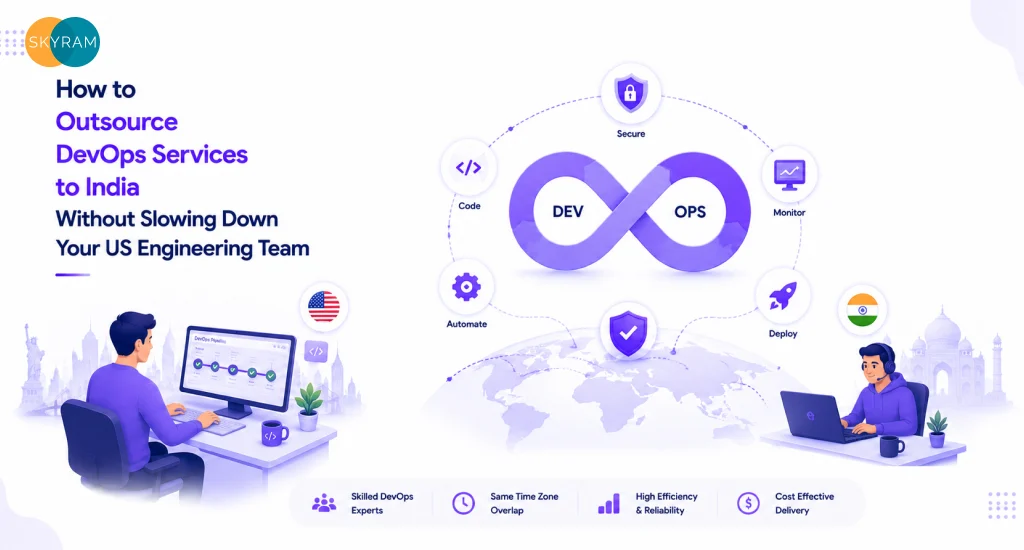
Choosing to outsource DevOps services in the USA through an Indian delivery team solves the capacity problem without the hiring timeline. The challenge is doing it in a way that does not introduce the coordination overhead, knowledge gaps, or communication friction that have made offshore engagements notorious for slowing teams down rather than accelerating them.
This guide covers what to get right before you sign a contract, how to structure the engagement for engineering velocity rather than against it, and how to evaluate whether an offshore DevOps vendor is equipped to operate as a true extension of your team.
What Offshore DevOps Services Actually Cover
The term DevOps vendor covers a wide range of capabilities, and not every firm delivers the same scope. Before evaluating any partner, clarify what your engagement needs to include and compare that against what each vendor genuinely specializes in rather than what their website claims.
Infrastructure Provisioning and IaC
This covers building and maintaining cloud infrastructure using Terraform, Pulumi, or AWS CDK. A mature offshore DevOps team writes infrastructure-as-code that your engineers can read, modify, and extend without needing the vendor present. Vendor-specific abstractions that hide the underlying configuration are a red flag.
CI/CD Pipeline Design and Maintenance
Pipeline work includes initial architecture, build and test stage configuration, artifact management, environment promotion workflows, and ongoing maintenance as your codebase evolves. Offshore teams that treat pipeline setup as a one-time deliverable rather than an ongoing responsibility leave you holding a fragile system the moment your stack changes.
Container Orchestration and Kubernetes Management
For teams running containerized workloads, this includes cluster provisioning, Helm chart development, namespace strategy, autoscaling configuration, and upgrade management. Kubernetes operations require daily attention, making it one of the clearest cases for a dedicated offshore DevOps services engagement rather than a project-based handoff.
Observability, Monitoring, and Incident Response
Monitoring setup, alerting configuration, dashboard development, and on-call coverage during agreed overlap hours fall into this category. The practical value of DevOps outsourcing for US companies appears sharply in this area: an offshore team running overnight monitoring shifts catches issues before your engineers start their day.
Security and Compliance Engineering
This includes secrets management, cloud security posture management, IAM policy design, vulnerability scanning in pipelines, and compliance framework implementation for SOC 2, HIPAA, or PCI-DSS depending on your industry. Not every offshore DevOps team has genuine depth here. Verify before assuming.
| Key TakeawayOffshore DevOps services span infrastructure, pipelines, Kubernetes, observability, and security engineering. The mistake most teams make is treating DevOps outsourcing as a single category rather than a set of distinct specializations. Define which capabilities your engagement requires before evaluating vendors, and verify each one independently rather than accepting a vendor’s general DevOps credentials at face value. |
Why the US-India Model Works for Engineering Operations
The case for DevOps outsourcing to India rests on three compounding advantages that become more significant the longer an engagement runs: specialization concentration, follow-the-sun coverage, and cost-to-output ratio.
Specialization Concentration
Indian DevOps firms that serve US product companies have built practices around AWS, Azure, GCP, Kubernetes, Terraform, and the modern CI/CD toolchain because those are the dominant environments their clients run. Engineers at these firms work across dozens of client environments annually, seeing failure modes and architectural patterns that in-house teams encounter once every few years. That accumulated pattern recognition produces faster diagnosis and better architectural decisions.
Follow-the-Sun Coverage Without Paging Your Engineers
A dedicated offshore DevOps team operating in the Indian Standard Time zone covers a natural overnight shift for US-based teams. Production incidents that surface at 2 AM EST reach an engineer who is four hours into their workday rather than a groggy on-call rotation member who will miss context. Your engineers start each morning with an incident summary rather than an active fire.
Cost-to-Output Ratio at Scale
The table below compares the cost and operational profile of building DevOps capability in-house against engaging an offshore DevOps services team. The numbers reflect current market conditions for mid-to-senior DevOps engineering talent.
| Factor | In-House DevOps Build | Offshore DevOps Vendor |
| Time to first pipeline | 3 to 6 months (hiring + ramp) | 4 to 8 weeks (dedicated team) |
| Cost per year (mid-senior) | $130K to $180K salary + benefits | $40K to $80K engagement cost |
| Toolchain breadth | Limited to hires’ experience | Multi-platform by default |
| Availability | Business hours, PTO-dependent | Overlap hours + async coverage |
| Knowledge continuity | Lost when engineer leaves | Documented + team-redundant |
| Compliance coverage | Requires specific expertise hire | Covered by specialized practice |
The output difference compounds over time. An offshore team of three to four engineers working dedicated hours on your environment produces more throughput than a single senior in-house hire who splits attention between DevOps work and product support requests.
| Key TakeawayThe US-India DevOps model delivers genuine engineering value through specialization depth, overnight coverage, and a cost profile that allows teams to staff DevOps functions that a single in-house hire cannot match. The follow-the-sun advantage is particularly material for teams that currently rely on on-call rotations for overnight coverage, where the human cost of 2 AM pages is real and measurable. |
How to Outsource DevOps Services in the USA Without Adding Coordination Overhead
The fear behind every offshore engagement is that the coordination cost will eat the efficiency gain. That fear is grounded in real experience. Poorly structured offshore DevOps engagements do create overhead, primarily through unclear ownership, excessive approval gates, and communication channels that route everything through project managers instead of between engineers.
The solution is not better project management software. It is a deliberate operating structure built into the engagement contract before the first sprint begins.
Define Ownership Boundaries at the Infrastructure Level
Map your infrastructure into explicit ownership domains. The offshore team owns the pipeline configuration, the cloud infrastructure modules, the Kubernetes cluster management, and the monitoring stack. Your engineers own application architecture decisions, deployment approval for production, and security policy definitions. Overlap zones get explicit escalation paths rather than implicit assumptions.
Teams that skip this mapping spend the first three months of an offshore engagement negotiating every decision in real time. Teams that document ownership domains in advance spend that time shipping.
Embed Engineers, Not Ticket Systems
Offshore DevOps teams that work through a ticketing queue rather than direct engineering channels introduce a structured delay into every decision. Your DevOps lead should have direct Slack or Teams access to the offshore engineers working on your environment. Pull request reviews should come from your team, not from a program manager summarizing technical feedback.
This structure requires the offshore vendor to assign named engineers to your account rather than a rotating pool. Name assignment is a negotiable contract term. Put it in writing.
Establish Async-First Communication with Timed Synchronous Windows
Fix a daily overlap window of two to three hours where both teams are available for live calls. Outside that window, require written decisions with context included in the message, not just the conclusion. An offshore engineer who writes ‘I changed the security group rule’ in a Slack message has transferred no useful information. An engineer who writes ‘I changed the security group rule for the data tier from port 5432 open to the VPC CIDR to open only to the application subnet CIDR, because the database was reachable from the bastion host’ has transferred a full audit record.
Run Infrastructure Changes Through Your Review Process
Offshore DevOps teams that bypass your code review and change management process for infrastructure work create shadow infrastructure your team cannot audit. Require all Terraform and Helm changes to go through pull requests reviewed by at least one in-house engineer. This is not distrust of the offshore team. It is the documentation and knowledge transfer mechanism that prevents your team from being dependent on the vendor for changes they should understand.
| Key TakeawayCoordination overhead in offshore DevOps engagements comes from structural decisions, not cultural or time zone differences. Define infrastructure ownership domains, require direct engineer-to-engineer communication channels, enforce async-first practices with written decisions, and route all infrastructure changes through your code review process. Teams that implement these structures before kickoff consistently report faster velocity than those that improvise coordination as the engagement runs. |
Evaluating an Offshore DevOps Vendor: What to Actually Look For
The DevOps vendor market in India ranges from mature engineering practices with deep specialization to staffing firms that relabel generalist engineers as DevOps. The evaluation criteria that distinguish them are specific enough that you can apply them in a single structured call.
Technical Assessment Over Portfolio Claims
Ask for a live technical discussion with the engineer who will work on your account, not a sales call with a solution architect. Present a realistic scenario from your environment: a failing Terraform plan, a pod restart loop, a CI pipeline that passes locally but fails in the runner. Evaluate how the engineer thinks through the problem, what questions they ask, and whether their diagnosis reflects genuine hands-on experience or surface-level pattern matching.
Toolchain Depth Across Your Specific Stack
Confirm the vendor has production experience with your exact tools, not just the general category. If you run ArgoCD for GitOps and plan to add Crossplane for infrastructure provisioning, you need a team that has operated both in production, not one that has read the documentation. Request references from clients with similar stack profiles.
Documentation and Knowledge Transfer Standards
Ask to review a sample runbook, architecture decision record, and incident postmortem from a comparable engagement. A vendor that cannot produce these on request either does not create them or creates them at insufficient quality. Documentation standards are the difference between a managed DevOps outsourcing relationship that transfers knowledge back to your team and one that builds dependency.
Security Practices and Compliance Experience
If your environment carries compliance obligations, verify the vendor’s specific framework experience. SOC 2 compliance in a SaaS pipeline is a different engineering problem from HIPAA compliance in a healthcare data environment. Ask which frameworks the vendor’s engineers have implemented, in what cloud environments, and in which year. Experience from five years ago on a different cloud platform is not equivalent to current operational knowledge.
Contract Structures That Protect Your Interests
Review the IP assignment clause, data processing agreement, and access revocation terms before any technical discussion. Your Terraform modules, pipeline configurations, and infrastructure architecture are proprietary assets. The contract should assign ownership to you explicitly and require the vendor to delete access within 24 hours of engagement termination. Vendors that resist standard IP assignment clauses are telling you something about how they operate.
| Key TakeawayEvaluating a DevOps vendor requires technical verification at the engineer level, not vendor-level marketing review. Live technical discussions, toolchain-specific reference checks, documentation quality review, and contract scrutiny each reveal information that a vendor presentation conceals. Run all four evaluations before shortlisting. The additional time spent on due diligence at the selection stage saves multiples in remediation during the engagement. |
Structuring the Engagement for Maximum Engineering Velocity
A well-selected DevOps vendor operating under a poorly structured engagement produces disappointing results. The engagement structure determines whether the offshore team accelerates your engineering team or operates as an adjacent function that your team has to manage like an additional project.
Sprint Zero: Discovery Before Any Build Work
Reserve the first two weeks exclusively for environment discovery. The offshore team audits your current infrastructure, maps dependencies, identifies technical debt that will affect delivery timelines, and produces an architecture proposal for review. No production changes during this period. Every minute spent in discovery reduces the number of surprises that surface during the build.
Teams that skip Sprint Zero because they feel behind schedule consistently encounter the same blockers two to four weeks later, with less time to address them and more code already committed on top of them.
Phased Delivery with Engineering Review Gates
Structure delivery in phases with explicit review gates where your engineering team evaluates the offshore output before the next phase begins. Infrastructure-as-code reviewed by your team before it runs against your cloud account. Pipeline configuration reviewed before it connects to your production deployment target. Each gate is a knowledge transfer opportunity as well as a quality checkpoint.
Runbooks Written Concurrently, Not at Handoff
Require documentation to be written as the work is built, not compiled at the end of the engagement. Offshore teams that document at the end of a sprint write from memory rather than from the decisions that occurred during implementation. The resulting documentation is thinner, less accurate, and harder for your team to use when an incident occurs at 11 PM.
Dedicated Point of Contact with Technical Authority
The offshore team’s point of contact to your organization should be a senior engineer with authority to make infrastructure decisions within the defined ownership domain, not a project manager who escalates every technical question to a team lead. Similarly, your primary contact to the offshore team should be your DevOps lead or a senior engineer, not a program manager intermediary. Direct technical accountability shortens every decision cycle.
Check out our Kubernetes solution models.
Quarterly Architecture Reviews
Schedule a quarterly review where the offshore team presents the current architecture state, documents decisions made in the preceding quarter, identifies technical debt accumulated, and proposes the next quarter’s priorities. This keeps the engagement aligned with your engineering direction rather than drifting toward what is convenient for the vendor.
| Key TakeawayEngagement structure is where offshore DevOps relationships succeed or fail. Sprint Zero discovery, phased delivery with engineering review gates, concurrent documentation, direct technical accountability, and quarterly architecture reviews each prevent specific failure modes. Build these into the statement of work, not as aspirational guidelines but as contractual delivery requirements with clear acceptance criteria. |
Managing Risks Specific to Managed DevOps Outsourcing USA Engagements
Every offshore DevOps engagement carries risks. The teams that manage them successfully identify the specific risks relevant to their situation before they materialize and address them in the contract and operating structure.
Vendor Dependency and Lock-In
An offshore DevOps team that builds your infrastructure using proprietary tooling, undocumented configurations, or vendor-specific automation creates operational dependency that is expensive to exit. Require open-standard tooling aligned with your existing stack. Infrastructure-as-code must be written in a format your engineers can modify independently. Configurations must be fully documented and owned by your organization.
Personnel Turnover on the Offshore Team
The engineer who built your Terraform modules leaving the vendor firm is a knowledge risk if documentation standards are weak. Mitigate this by requiring architecture decision records for every significant infrastructure choice, naming multiple engineers on the offshore account rather than one, and verifying that code review processes force knowledge distribution across the team rather than concentrating it in one person.
Security Exposure from Broad Access Grants
DevOps work requires meaningful cloud access, which creates attack surface if managed poorly. Scope access to the minimum required for each phase. Use IAM roles with time-bound session tokens rather than long-lived credentials. Require the offshore team to operate through your secrets management system. Audit access logs quarterly and revoke access for completed work phases promptly.
Scope Creep in Open-Ended Support Engagements
A support retainer that starts with pipeline maintenance gradually absorbs database tuning requests, application performance debugging, and ad hoc infrastructure changes outside the original scope. Define the support boundary in writing with examples of what falls inside and outside scope. Establish a change order process for out-of-scope work. Review the scope boundary at each quarterly architecture review.
Communication Degradation Over Time
Offshore engagements that start with strong communication practices often drift toward minimal async updates as both teams settle into a rhythm. Schedule a monthly communication audit where both teams review whether decisions are documented adequately, whether async messages include sufficient context, and whether the overlap window is being used effectively. Communication quality degrades gradually rather than suddenly, making explicit review necessary.
| Key TakeawayVendor dependency, personnel turnover, security exposure, scope creep, and communication degradation are predictable risks in offshore DevOps engagements. Each one has a specific mitigation that belongs in the engagement contract and operating structure. Teams that address these risks at the outset handle them as process questions rather than operational crises when they surface. |
Frequently Asked Questions About Outsourcing DevOps Services
The following answers address specific decision points for CTOs and VPs of Engineering evaluating offshore DevOps partnerships.
What does it mean to outsource DevOps services in the USA to an Indian team?
Outsourcing DevOps services to an Indian team means engaging a specialized offshore firm to handle your infrastructure provisioning, CI/CD pipeline operations, Kubernetes management, monitoring, and DevOps security engineering. The offshore team works as an extension of your engineering function, operating within your toolchain, following your process standards, and communicating directly with your engineers. The distinction from traditional outsourcing is the level of technical integration: the team works inside your environment with defined ownership rather than operating on a separate infrastructure track.
How do offshore DevOps teams avoid slowing down engineering velocity?
Offshore DevOps teams avoid slowing engineering velocity when they have direct communication channels to your engineers rather than routing through project managers, when ownership domains are clearly defined so they make decisions without constant approval, and when they operate on an async-first communication model that documents decisions rather than deferring them to the next sync window. The structural setup of the engagement, not the time zone difference, is the primary determinant of whether an offshore team accelerates or slows your engineering team.
What engagement model works best for DevOps outsourcing for US companies?
A dedicated offshore DevOps team works best for US companies that need ongoing infrastructure operations, continuous pipeline maintenance, and overnight monitoring coverage. Staff augmentation works better for companies that have an existing DevOps function but need specific expertise for a migration or new platform deployment. Project-based engagements suit teams that want a specific deliverable, such as a production-grade CI/CD pipeline or a Kubernetes cluster setup, with a defined end date and complete ownership transfer. The right model depends on your current internal DevOps maturity and how much ongoing operational involvement you want to retain in-house.
How much does it cost to outsource DevOps services to India?
Offshore DevOps engagement costs vary by team size, seniority, and scope. Dedicated teams of two to four engineers typically bill between $40,000 and $80,000 annually depending on seniority level and the depth of specialization required. Project-based engagements for specific deliverables like pipeline setup or infrastructure migration are often quoted as fixed-scope contracts. The relevant comparison is not the absolute cost but the cost relative to the equivalent in-house team, which for mid-to-senior US DevOps engineers runs $130,000 to $180,000 per person annually before benefits and equity.
What security controls should I require when giving an offshore DevOps team cloud access?
Require IAM roles scoped to the minimum permissions necessary for each phase of the engagement rather than broad admin access. Use time-bound session tokens for production environment access. Require the offshore team to operate through your secrets management system rather than holding long-lived credentials directly. Enable CloudTrail or equivalent audit logging for all API activity by the offshore team’s role. Review access logs quarterly and revoke permissions for completed phases promptly. Document the access grant and revocation process in the engagement contract so it executes automatically at engagement milestones.
How do I prevent vendor dependency when outsourcing DevOps to India?
Prevent vendor dependency by requiring open-standard tooling rather than vendor-proprietary abstractions, enforcing architecture decision records for every significant infrastructure choice, maintaining in-house pull request review on all infrastructure code changes, requiring documentation to be written concurrently with implementation rather than at the end of the engagement, and ensuring at least two engineers on the offshore account are familiar with every major infrastructure component. The practical test: if the vendor firm closed tomorrow, could your team operate and modify the infrastructure independently? If not, the engagement has created dependency that the contract and documentation standards should address.
What should a DevOps vendor handoff package include at the end of a project-based engagement?
A complete handoff package should include a full infrastructure architecture diagram with component annotations, all Terraform or equivalent IaC modules in your version control system, documented IAM roles and policies with the rationale for each permission, CI/CD pipeline configuration files with inline comments, monitoring dashboards and alert configurations with threshold rationale, a runbook covering the ten most likely operational scenarios including recovery steps, incident postmortems from any issues encountered during the engagement, a recorded video walkthrough of the complete environment, and a live knowledge transfer session with your engineering team. Any engagement that does not deliver all of these by the contract end date has not completed delivery regardless of whether the infrastructure is operational.
| Talk to a DevOps Specialist at Skyram Technologies
Skyram Technologies works with US engineering teams to deliver offshore DevOps services that integrate with your existing processes, toolchain, and release cadence. If your infrastructure backlog is blocking engineering velocity and you want to evaluate what a structured offshore DevOps engagement looks like for your environment, start the conversation. Visit skyramtechnologies.com/devops/ to connect with our engineering team. |
Explore Skyram’s DevOps services to review scope, team structure, and engagement options.