

Your next customer may discover your product through an AI-generated comparison before visiting your store. Will that comparison show the right product, price, and features?
For an e-commerce director, that question goes beyond content marketing. It involves your product catalog, category structure, customer reviews, inventory systems, and the connections between them.
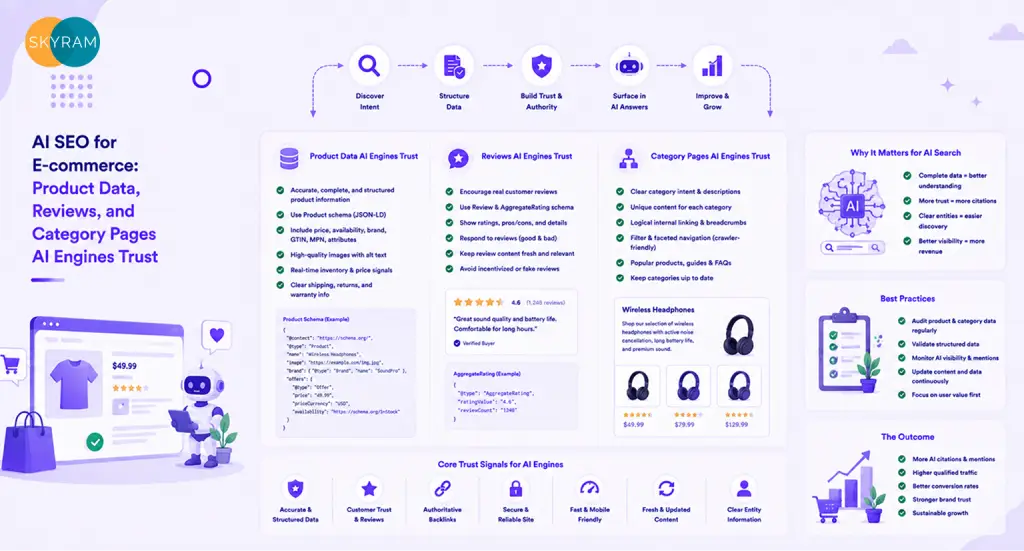
AI SEO for ecommerce means making your products and shopping information discoverable, understandable, and consistent across search and AI-assisted shopping experiences. It combines established SEO practices with accurate product records, helpful buying guides, authentic reviews, and connected site architecture.
A compelling product description cannot make up for conflicting information. If your product page shows one price, your feed shows another, and checkout says the item is unavailable, your shopping experience has a reliability problem.
The same applies to discovery. A product buried behind an internal search box or disconnected from relevant categories can be harder to find.
Google states that existing SEO fundamentals apply to AI Overviews and AI Mode. There is no special AI schema or additional technical requirement for inclusion. Pages must be indexed and eligible to appear in Search with a snippet, but meeting those requirements does not guarantee selection.
The opportunity is not a secret AI optimization trick. It is a better-connected online store that gives shoppers and discovery systems a clear, consistent picture of what you sell.
Build Connected Commerce Architecture
Give every page a purpose.
Your store should work as a connected shopping journey, not a collection of competing landing pages.
Category pages organize choices. Product pages explain specific items. Buying guides clarify trade-offs. Reviews share customer experiences. Policy pages explain shipping, returns, and other purchase conditions.
Each page should answer a different question.
| Page type | Primary responsibility | Example |
| Category page | Help shoppers explore a product family | Standing desks |
| Subcategory page | Address a meaningful shopping subset | Compact standing desks |
| Product page | Explain a specific product and its options. | An adjustable desk model |
| Buying guide | Explain selection criteria. | How to choose a standing desk |
| Comparison page | Clarify differences between alternatives. | Electric versus manual standing desks |
| Policy page | Explain transaction conditions | Shipping, returns, and warranties |
This separation prevents every page from targeting the same broad keyword with slightly different wording.
A category page should help visitors narrow their options. A product page should explain whether a specific item meets their needs.
A buying guide can provide more detailed advice, then direct readers to the right collection.
Google recommends linking from menus to categories, from categories to subcategories, and from subcategories to products. It also uses relationships between pages to understand their relative importance within a website.
For AI SEO for ecommerce, this architecture creates a practical foundation: discoverable products supported by clear, useful context.
Make priority products easy to find.
A product should not depend entirely on your website’s internal search feature for discovery.
Google generally does not submit searches into a website’s search box when crawling. Its guidance recommends linking to products you want indexed, with sitemaps or Merchant Center feeds providing additional discovery paths when needed.
Check whether your priority products are accessible through category navigation.
Look beyond the first screen of a collection. If additional products appear through infinite scrolling, make sure the implementation provides a crawlable path to them.
Use standard links rather than interactions that rely entirely on JavaScript click events. Google specifically recommends HTML anchor elements with an href attribute.
These issues often come from platform behavior rather than copy. Skyram’s e-commerce development services cover storefront development, product management, and integrations that can support a more connected shopping experience.
Control filters and category overlap
Filters help shoppers narrow products by size, material, price, or features. However, not every filter combination needs a separate indexable page.
A collection for “compact standing desks” may address a meaningful shopping need. A temporary combination of color, sort order, availability, and tracking parameters may not.
Before creating a permanent filtered collection, ask:
- Does it address a distinct shopping need?
- Does it have a stable, relevant product selection?
- Can it provide helpful guidance beyond the parent category?
- Will it remain useful after a promotion ends?
Also check for overlapping categories.
“Small office desks,” “compact office desks,” and “desks for small offices” may not need three separate pages if they feature the same products and guidance.
A different title alone does not create a different shopping experience. Google’s canonicalization guidance notes that sufficiently differentiated content can help distinguish pages that have been grouped as duplicates.
The goal is a clear category structure, not the largest possible collection tree.
Align URLs and sitemaps.
Your sitemap, internal links, and canonical signals should support the same preferred URLs.
Google recommends using consistent URLs across internal links, sitemap files, and canonical tags. It also recommends including canonical URLs in sitemaps rather than every variation that leads to the same content.
A useful audit separates three issues:
| Issue | What it means | What to investigate |
| Repeated sitemap entry | The same URL appears more than once. | Sitemap generation and unnecessary repetition |
| Duplicate content URLs | Different URLs show substantially similar content. | Preferred URL and conflicting signals |
| Overlapping categories | Several collections address the same need. | Assortment, purpose, and differentiation |
A repeated URL is not the same problem as several competing URLs for one product.
Sitemap inclusion is also a weaker canonical signal than redirects or canonical annotations. A sitemap alone cannot resolve conflicting implementation.
For a broader explanation of discovery and technical accessibility, read Skyram’s guide to the technical SEO foundation for AEO.
Make Product Data Consistent
Establish a shared product record.
Product information moves through several systems: your storefront, structured data, merchant feeds, inventory platform, and checkout.
Those systems should describe the same product and offer.
Consider a hypothetical running shoe. The product page lists a blue women’s size 8 at $120. The feed lists $110, while checkout shows that size and color as sold out.
That inconsistency can mislead shoppers regardless of how they find the item.
Start with a shared product record that separates stable product details from changing purchase information.
Stable fields include:
- Product name and brand.
- SKU and applicable manufacturer identifiers.
- Model and product family.
- Materials, dimensions, and compatibility.
- Relationships between product variants.
Changing fields include
- Price and sale price.
- Currency.
- Availability.
- Shipping conditions.
- Promotion dates.
Assign ownership to both groups. Merchandising may approve descriptions and product attributes, while commerce operations maintain inventory and pricing.
Without clear ownership, accuracy depends on someone catching an error.
Explain verified product differences.
Helpful product content tells shoppers what an item does, where it fits, and what its limitations are.
“Premium quality for everyday use” provides little support for a purchase decision.
For a standing desk, customers may need desktop dimensions, adjustment range, weight capacity, frame material, assembly requirements, and warranty details.
Pair factual specifications with practical explanations.
For example:
“The desktop measures 48 inches wide, making it a good option for smaller home offices. Check your monitor and accessory footprint before choosing this size.”
That is more helpful than saying the desk is “perfect for every workspace.” Keep specifications tied to approved product records. AI-assisted writing can help explain those facts, but it should not invent materials, certifications, dimensions, or compatibility.
For US shoppers, make prices, shipping destinations, return conditions, and measurement units clear. Where applicable, display prices in US dollars and dimensions in inches. The objective is not longer descriptions. It is fewer unanswered purchase questions.
Preserve variant accuracy.
A product family and a purchasable variant are related, but they are not identical.
Size, color, material, and configuration can change the price, images, availability, or suitability of an item.
Your data model should preserve those differences.
OpenAI’s product-feed specification instructs merchants to submit one row per purchasable item or variant. It includes product attributes, prices, shipping, returns, and review information.
Your storefront’s variant URL strategy will depend on the platform and shopping experience. Regardless of the URL format, verify that a selected variant displays the correct:
- Image.
- Price.
- Stock status.
- Identifier.
- Size or configuration.
- Purchase option.
A shopper following a recommendation for a specific configuration should not land on a different option without a clear explanation.
Match structured data to reality
Structured data should label the information on your page, not publish a more attractive version of the offer.
Google supports product structured data that can enable richer search appearances, including price, availability, ratings, and shipping information. These appearances are not guaranteed.
Use applicable product and offer properties, then validate them against what shoppers actually see.
A practical check compares three representations:
- The visible product page.
- The page’s structured data.
- The submitted merchant feed.
All three should agree on the relevant product identity and purchase details.
Google’s AI search guidance specifically recommends matching structured data to visible content and keeping Merchant Center information current. It does not require special AI markup.
Recheck these relationships after pricing changes, template updates, and review-platform migrations.
Treat feeds as publishing systems.
A product feed needs quality control, not just successful file generation.
OpenAI allows merchants to apply to share product data for shopping experiences in ChatGPT. Its merchant page highlights detailed information such as images, pricing, and reviews. Participation does not guarantee product recommendations.
Check feed completeness, landing-page alignment, variant accuracy, and changing purchase information.
Set refresh processes based on inventory volatility and destination requirements. A frequently changing catalog needs different controls than a made-to-order business.
Also validate against current platform documentation. An older feed template may no longer reflect the destination’s requirements.
If your publishing tools cannot manage shared attributes, approvals, and integrations, address that workflow before adding more disconnected tools. Skyram’s custom CMS development services include content models, permissions, and integrations that can support controlled publishing.
Use Reviews and Category Guidance
Collect reviews that help shoppers.
A star average offers a quick signal. Detailed reviews explain the experience behind it.
Helpful feedback can address fit, setup, performance, durability, compatibility, and limitations.
For a standing desk, a customer might explain how it fits a small apartment or whether assembly required another person.
Those details help future buyers decide whether the product fits their needs. “Great product” offers much less context.
Encourage customers to describe their experience without steering them toward a positive rating.
Also distinguish product reviews from seller-service feedback. Delivery delays matter, but they do not establish whether a desk is stable or well built. Clear labeling keeps those different signals understandable.
Preserve review integrity.
Explain how reviews are collected and moderated. Use a verified-purchase label only when the purchase was verified. Apply moderation rules consistently and disclose relevant incentives.
Do not generate customer testimonials or rewrite feedback into claims the customer never made. When summarizing reviews, preserve meaningful qualifications. A few positive comments do not justify saying every customer agrees.
Review summaries should also remain separate from verified technical specifications or laboratory testing.
OpenAI’s feed specification states that review count and rating must describe the same review population. Apply that principle across the page, markup, and feed.
Your displayed rating should not represent one set of reviews while the count represents another.
Turn feedback into better information
Reviews can reveal gaps in your product pages.
Repeated sizing complaints may point to an unclear measurement guide. Assembly questions may reveal missing instructions. Compatibility complaints may identify an unsupported use case.
Create a process for reviewing those patterns with the appropriate product specialists.
If customers repeatedly ask whether a desk supports a dual-monitor arm, verify the answer before updating the product record.
Do not use a customer review alone to establish a technical capability. The operational insight is important: feedback should improve product information, not remain isolated in a review widget.
Add independent product evidence.
Your website explains products from the seller’s perspective. Independent reviews and editorial coverage can provide other perspectives.
Effective outreach starts with something worth evaluating: a testable feature, a differentiated design, transparent research, or access to a knowledgeable product expert.
Avoid asking publishers to repeat unsupported “best in class” claims.
Skyram’s guide to digital PR for AEO and GEO explores third-party coverage as part of an AI visibility strategy. For e-commerce teams, the practical objective is credible product discussion, not a promise that every mention will become an AI citation.
Make categories help shoppers choose.
A category page should do more than display inventory. Its introduction should explain what the collection contains and which differences matter.
For standing desks, the main decisions could include electric versus manual adjustment, desktop dimensions, equipment requirements, and assembly conditions.
Use criteria that match the product family.
Clothing may require fit and fabric guidance. Electronics may require compatibility details. Furniture may require dimensions, materials, and installation information.
A short explanation near the top can orient shoppers. More detailed selection guidance can appear after the product grid without overwhelming the browsing experience.
Avoid copying the same paragraph about “quality, affordability, and style” across every collection.
Connect guidance to products.
Supporting content should connect naturally with the catalog.
A laptop collection might link to a memory and storage guide. A furniture collection might link to a room-measurement guide.
Those resources should direct readers back to relevant products and categories.
Google recommends linking to important products from other site content, including blog posts, to help communicate their importance within the website.
Internal linking is therefore a merchandising decision as well as an SEO task.
Skyram’s SEO services for e-commerce and retail include category and product architecture optimization. The useful principle is to align discovery paths with purchase decisions rather than adding links simply to increase their number.
Run a Measurable Improvement Program
Start with one valuable category.
Do not begin by rewriting the entire catalog. Choose a category with meaningful business value, reliable inventory, and identifiable information gaps.
Review its complete shopping journey:
- Can shoppers find the category through navigation?
- Are priority products accessible through its links?
- Do product attributes answer purchase questions?
- Do pages and feeds agree on price and stock?
- Do reviews reveal unresolved concerns?
- Does supporting content connect to the product selection?
- Are shipping and return conditions clear?
This creates a focused backlog instead of an unmanageable sitewide task list. It also separates content problems from architecture, development, and operational issues.
Assign clear responsibilities
AI SEO for ecommerce becomes easier to manage when ownership is explicit.
| Workstream | Suggested owner | Main responsibility |
| Category architecture | SEO and merchandising | Organize meaningful shopping destinations. |
| Product attributes | Product or merchandising team | Verify specifications and differentiators. |
| Price and availability | Commerce operations | Maintain current commercial information |
| Templates and rendering | Development | Keep pages accessible and consistent. |
| Reviews | Customer experience | Collect and moderate genuine feedback. |
| Feeds and structured data | Technical SEO and development | Validate published representations |
| Measurement | Analytics and e-commerce leadership | Connect performance with business outcomes. |
The e-commerce director should own priorities and escalation, not every individual field.
A pricing mismatch needs a defined response. It should not sit in a content spreadsheet until the next monthly review.
Define completion criteria.
“Optimize this category for AI” is too vague for a useful project brief.
Set observable acceptance criteria instead.
For a pilot category, completion could require:
- Priority products are accessible through category navigation.
- Required specifications come from approved records.
- Selected variants show the intended configuration.
- Product pages and feeds agree on purchase information.
- Rating summaries match the underlying reviews.
- Internal links use preferred URLs.
- Category guidance explains meaningful differences.
- Purchase policies are easy to find.
These criteria prevent the project from becoming a copywriting exercise that leaves system-level problems unresolved.
Keep catalog changes traceable.
Quality can decline after a successful optimization project. A template update might change canonical tags. A catalog import might replace verified specifications. A review integration might alter displayed ratings.
For significant changes, record the affected templates or product groups, source system, approver, and validation results. Check technical behavior as well as appearance.
Google notes that CMS or plugin misconfigurations can introduce incorrect canonical elements. Its troubleshooting guidance recommends examining rendered HTML and investigating unexpected signals.
A page can look correct while publishing conflicting technical instructions.
Separate readiness from performance.
A technically sound page is ready to compete. It is not guaranteed to rank or receive an AI citation.
Track readiness and performance separately. Readiness includes crawl access, indexation, product markup, feed acceptance, data consistency, and internal discoverability.
Performance includes organic traffic, product engagement, conversion rate, revenue, and observable AI referrals.
For sampled AI responses, record the platform, query, date, market context, cited URL, and factual accuracy. A product mention and a citation to your website are different outcomes. Report them separately.
Also check whether the response describes the right variant and purchase conditions. Visibility with inaccurate information is not a complete success.
Google reports traffic from its AI features within Search Console’s overall web performance data. Standard reporting should not be presented as a complete, separate AI overview attribution dashboard.
Expand based on the pilot.
Suppose a standing-desk audit reveals inconsistent dimensions, confusing collections, outdated feed prices, and buying-guide links pointing to URL variations.
Another general blog post would not resolve those issues. A stronger approach would standardize product records, clarify category choices, fix variant journeys, and align preferred URLs.
Afterward, assess what caused the recurring problems. A shared-data issue needs a catalog solution. A navigation issue needs architecture changes. Weak selection guidance needs input from product specialists.
Scale the solution that addresses the cause, not a generic rewrite across thousands of pages.
For teams looking for an external starting point, Skyram Technologies offers an AI visibility audit. Pair that diagnostic with a commerce architecture review to identify whether the main gap involves access, product accuracy, supporting evidence, or content coverage.
The objective is not to make every page sound optimized for AI. It is to build a store that consistently explains what you sell, who it is right for, and what customers can expect.
Frequently Asked Questions
What is AI SEO for e-commerce?
AI SEO for ecommerce makes products and shopping information easier to discover and understand across search and AI-assisted experiences. It combines accessible architecture, accurate product data, helpful category guidance, authentic reviews, and consistent feeds. It does not guarantee rankings or recommendations.
How can my products appear in ChatGPT?
Maintain accessible product pages with accurate descriptions, pricing, availability, and variant information. Merchants can also apply to share product feeds with OpenAI. Feed participation supports product discovery but does not guarantee that ChatGPT will display or recommend a particular item.
Do I need a special schema for AI Overviews?
No. Google says AI Overviews and AI Mode do not require a special schema or additional technical optimization. Pages must meet normal search requirements, be indexed, and be eligible for snippets. Relevant structured data should match the visible page.
How do reviews support product discovery?
Reviews add customer experience about fit, performance, durability, and limitations. They help shoppers evaluate suitability and can reveal missing product information. Keep feedback authentic and ensure that displayed ratings and review counts describe the same underlying review population.
How should category pages be optimized?
Give each category a clear shopping purpose, helpful selection guidance, and crawlable links to relevant products. Differentiate collections through meaningful product selections and information, not title changes alone. Google identifies internal discoverability and people-first content as relevant to its AI-search experiences.
Can AI write product descriptions?
AI can help draft descriptions from approved product information. Verify specifications, materials, compatibility, and claims before publishing. Use it to explain genuine differences clearly, not to invent missing attributes or produce interchangeable descriptions that fail to answer shoppers’ questions.
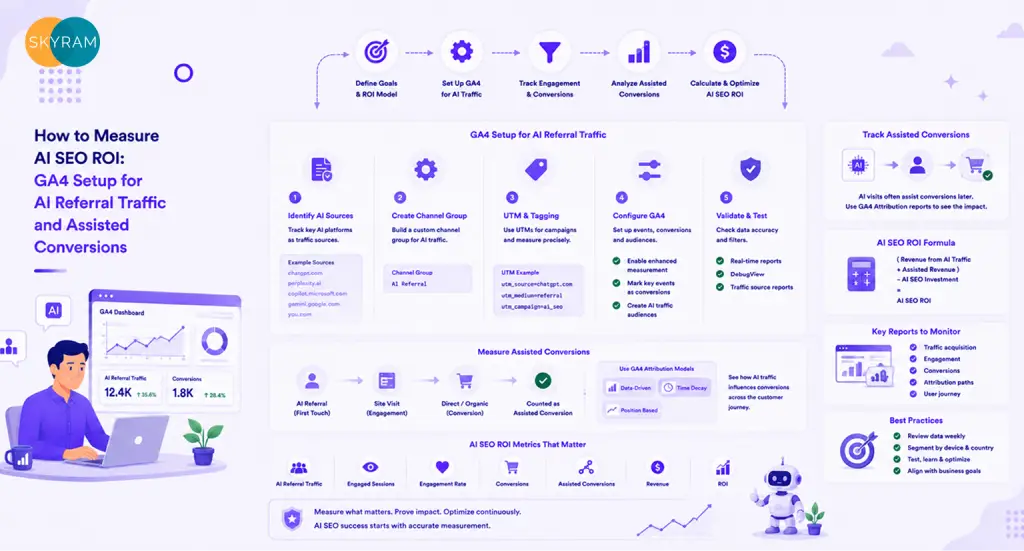
How do I measure AI SEO results?
Track technical readiness, organic performance, conversions, and observable AI referrals separately. Record product mentions, cited URLs, and factual accuracy in sampled AI responses. Google’s AI-feature traffic appears within Search Console’s overall web reporting, not a complete standalone attribution report.