

A VP Marketing approves an AEO initiative in Q1, reports it to the board as a strategic priority, and then faces an uncomfortable question in the Q2 review: where are the results. This is one of the most common failure points in answer engine optimization programs, and it rarely has anything to do with the quality of the work. It happens because nobody set a realistic timeline before the program started, so every internal stakeholder is measuring progress against an expectation that was never accurate in the first place.
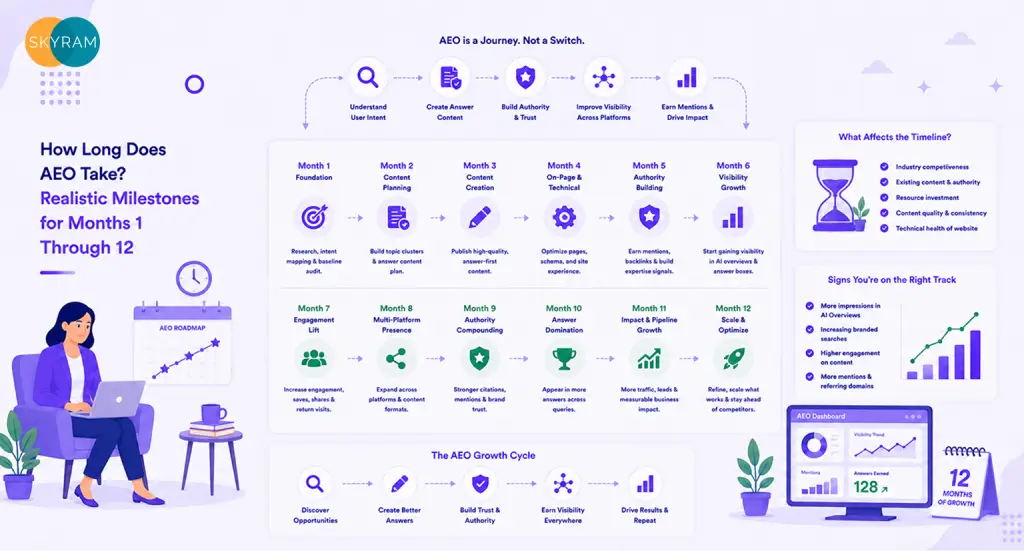
AEO does not produce results on a single, universal schedule, but it does follow a predictable shape. Early technical and structural work in months 1 and 2 produces no visible citation movement. Initial citations on lower-competition queries typically begin appearing between months 2 and 4. Measurable, board-reportable citation coverage across a brand’s core query set generally takes 4 to 6 months to build, and compounding authority that is difficult for competitors to displace develops over 9 to 12 months.
This piece breaks that arc down month by month, explains what actually drives the pace at each stage, and gives a VP Marketing the language to set expectations with leadership before the first report lands on anyone’s desk.
Why There Is No Single Answer to “How Long Does AEO Take”
Before walking through the month-by-month timeline, it helps to understand why the honest answer to this question is always a range rather than a fixed number.
The variables that actually control AEO timing
Four factors do most of the work in determining whether a brand sees citations in month 2 or month 6. The first is starting technical health: a site with clean crawlability, fast load times, and no structured data errors moves faster than one that needs a technical remediation phase before any content work can take effect. The second is content volume and quality already in place: a brand with substantial existing content that needs restructuring moves faster than one building an AEO-ready content library from zero. The third is query competitiveness: a niche B2B category with few competitors publishing AEO-structured content produces citations faster than a crowded consumer category where dozens of brands are already optimized. The fourth is publishing and update cadence during the engagement itself, since AI platforms re-crawl and re-index on their own schedules, and a program that publishes once and waits moves slower than one maintaining a consistent cadence.
Why AI platform re-indexing schedules affect every timeline
Unlike a paid campaign that goes live the moment a budget is approved, AEO results depend on when ChatGPT, Perplexity, Gemini, and Google’s AI Overviews next crawl, process, and incorporate updated content into their retrieval systems. Google’s AI Overviews pull from a continuously updated index, so changes can appear in result sets within days to weeks of a page being re-crawled. Training-data-dependent aspects of ChatGPT’s knowledge can lag further behind, though ChatGPT’s search and browsing features that retrieve live web content operate closer to real time. This means two pieces of otherwise identical content, published on different platforms’ crawl schedules, can show citation movement at noticeably different speeds, and no agency or in-house team controls that schedule directly.
Key Takeaway: AEO timing is not a single number because it depends on starting technical health, existing content quality, how competitive the target queries are, and the publishing cadence maintained throughout the engagement. Understanding these variables before setting a timeline internally prevents a mismatch between what leadership expects and what the discipline can actually deliver.
Months 1 and 2: Foundation Work With No Visible Movement Yet
The first stretch of any AEO program is the hardest to report on internally, because the work is real and substantial, but none of it is visible yet in AI-generated answers.
The audit and technical baseline
Month 1 typically covers a full citation baseline audit: running the brand’s priority buyer queries across ChatGPT, Perplexity, Gemini, and Google’s AI Overviews, logging which sources get cited today, and identifying where competitors are winning citations the brand is not. Alongside this, the technical SEO foundation an AEO strategy depends on gets audited for crawl errors, indexation gaps, page speed issues, and structured data problems, because none of the content work that follows can produce results if AI crawlers cannot reliably access the site.
Entity and schema groundwork
Month 2 is typically when entity and schema groundwork goes live: Organization schema with a complete sameAs array, Person schema for named authors, and corrected Article schema linking content to verified entities. This work is foundational rather than content-facing, which means it rarely produces a citation on its own in month 2, but it is a prerequisite for the content restructuring that follows to actually register as credible with AI retrieval systems.
Setting internal expectations for this phase
The single most useful thing a VP Marketing can do in months 1 and 2 is brief the leadership team that this phase will show zero citation movement by design, and that this is not a sign the program is behind schedule. A monthly report in this window should show completed audit findings, a prioritized content roadmap, and baseline citation numbers established, not citation growth. Setting this expectation before the first report lands avoids the single most common cause of AEO programs losing internal support prematurely.
Key Takeaway: Months 1 and 2 are foundation months. The audit, technical remediation, and entity and schema groundwork are necessary prerequisites, but they do not produce visible citation movement on their own, and internal reporting should be framed around completed foundation work rather than citation growth during this window.
Months 2 Through 4: First Citations on Lower-Competition Queries
This is typically the first window where a VP Marketing can show leadership something concrete happening in an actual AI platform, even if it is early and partial.
What early citation signals actually look like
Early citations tend to appear first on lower-competition, more specific queries rather than a brand’s primary head-term keywords. A niche definitional question or a narrow comparison query is far more likely to produce an early citation than a broad, highly contested category term. This is a normal and expected pattern, not a sign that the program is underperforming on the harder queries. Comparison content built with disclosed methodology and balanced competitor treatment tends to be among the first content types to earn citations in this window, because AI systems can evaluate its credibility signals quickly against the self-promotional comparison content most competitors still publish.
Content restructuring reaching AI platforms
By this point, restructured content, including FAQ sections rewritten for self-contained, third-person extraction rather than context-dependent, first-person phrasing, should be live on a brand’s highest-priority pages. The gap between publishing restructured content and seeing it reflected in AI answers varies by platform, which is why tracking needs to run across ChatGPT, Perplexity, and Gemini separately rather than treating AI citation as a single combined metric.
What a VP Marketing should report at this stage
A board-ready update at the end of month 4 should include the number of distinct queries where the brand now appears as a cited source, which platforms are showing citations first, and which content types are producing the earliest wins. This is also the point where it becomes useful to compare citation trend lines against the original baseline audit, since the delta, not the absolute number, is what demonstrates the program is moving in the right direction.
| Program Stage | Typical Timeframe | What Leadership Should See |
| Baseline and technical audit | Month 1 | Completed audit findings, prioritized roadmap, zero citation change |
| Entity and schema groundwork | Month 2 | Schema deployment confirmation, no citation change expected |
| First citation appearances | Months 2 to 4 | Citations on narrow, lower-competition queries; platform-by-platform variance |
| Core query set coverage | Months 4 to 6 | Growing citation frequency across the originally audited priority query list |
| Compounding authority | Months 6 to 9 | Citation presence extending into adjacent, related queries not originally targeted |
| Mature, defensible positioning | Months 9 to 12 | Consistent citation across core queries; harder for new competitors to displace |
Key Takeaway: Months 2 through 4 typically produce the first real citation evidence, usually on narrow, lower-competition queries rather than a brand’s hardest head terms. This window is when a VP Marketing has something concrete to show leadership, even though broad category coverage is still months away.
Months 4 Through 6: Measurable Coverage Across the Core Query Set
This is the window most B2B AEO programs point to as the point where the investment starts looking like a program rather than an experiment.
Why this window is the realistic target for “meaningful” results
By month 4 to 6, a well-executed program should show growing citation frequency across the bulk of the query list established in the original baseline audit, not just the easiest handful of queries. This is the stage where citation presence starts correlating with other signals leadership already tracks, including branded search volume and direct traffic, because buyers who encountered the brand in an AI answer often search the brand name directly rather than clicking through an AI-generated citation link.
Why competitive categories push this window later
A brand competing in a category where several competitors have already invested in AEO for a year or more should expect this window to extend closer to 6 months than 4, because citation share in a contested category is won incrementally against entrenched competitors rather than against an empty field. This is not a program failure. It is a function of how crowded the specific query space is, and it is worth setting this expectation explicitly with leadership at the start of the engagement rather than discovering it mid-program.
Reporting that actually demonstrates progress at this stage
The most useful reporting format at month 4 to 6 compares the current citation rate against the month 1 baseline across the full priority query list, broken out by platform. A query-by-query trend view, run consistently on the same cadence, is far more convincing to a skeptical CFO or CEO than a single aggregate “visibility score” that cannot be traced back to specific, verifiable AI outputs.
Key Takeaway: Months 4 through 6 are the realistic window for measurable, defensible citation coverage across a brand’s core query set. Competitive category density can push this timeline closer to month 6, and reporting that traces specific queries against the original baseline is more credible to leadership than any single aggregate score.
Months 6 Through 9: Compounding Authority and Adjacent Query Growth
The second half of the first year is typically where AEO programs start producing returns beyond the original target query list.
How citation presence compounds beyond the original query list
A brand that has built consistent citation presence across its core queries by month 6 often starts appearing in adjacent queries it was never specifically optimized for, because AI retrieval systems are increasingly confident in the brand’s entity credibility and topical authority across the broader subject area. This compounding effect is one of the clearest differences between AEO and paid acquisition channels, where visibility stops the moment spend stops. A fully built-out generative engine optimization program that establishes broad topical authority, not just individual optimized pages, is what produces this spillover effect.
What drives the compounding effect specifically
Three things typically drive this expansion: a growing library of interlinked, topically related content that signals depth to AI retrieval systems beyond any single page; an expanding and increasingly consistent sameAs and entity footprint that makes the brand easier to cross-reference across platforms; and sustained publishing cadence, since AI systems appear to weight recency and consistency of coverage when choosing between competing sources for a given topic.
Setting expectations for this phase
This is a good point in the program for a VP Marketing to shift the internal conversation from “are we getting cited” to “how much adjacent territory are we winning that we did not specifically target.” That reframe is useful because it demonstrates the program is producing compounding value rather than requiring linear, proportional investment to maintain the same result.
Key Takeaway: Months 6 through 9 are typically when citation presence starts compounding into adjacent queries beyond the original target list, driven by accumulated content depth, a stronger entity footprint, and sustained publishing consistency. This compounding pattern is one of the strongest arguments for treating AEO as a durable asset rather than a campaign with a fixed end date.
Months 9 Through 12: Mature, Defensible Positioning
By the end of the first year, a well-run AEO program should look meaningfully different from where it started, both in citation volume and in how resilient that citation presence is against new competitive entries.
What “mature” AEO positioning actually looks like
At the 9 to 12 month mark, a mature program shows consistent, repeatable citation presence across the core query set, meaningful presence in adjacent queries built up during months 6 through 9, and a content and entity foundation that makes it measurably harder for a new competitor entering the category to displace the brand’s position quickly. This last point matters most to leadership, because it reframes AEO from an ongoing cost center into a competitive moat that compounds the longer it runs.
Why displacement gets harder over time
A brand with twelve months of consistent citation history, a fully built entity graph, and ongoing publishing cadence presents a materially harder target for a competitor to out-cite than a brand with a handful of optimized pages published in the last quarter. AI retrieval systems weight established, consistent, cross-referenced sources, and that consistency is exactly what a competitor starting fresh cannot replicate in a 60 or 90 day sprint, regardless of budget.
What happens after month 12
AEO does not have a natural end point the way a campaign does. The twelve-month mark is a meaningful milestone for reporting and reassessment, not a finish line. Programs that continue past month 12 typically shift emphasis from building initial coverage to defending and expanding it, incorporating new query opportunities as buyer language and AI platform behavior continue to evolve.
Key Takeaway: By months 9 through 12, a mature AEO program has built citation presence that is both broad and defensible, making it significantly harder for new competitors to displace. This durability, not any single citation count, is the strongest argument for treating the twelve-month mark as a milestone rather than a deadline.
How to Set the Right Internal Expectations From Day One
The single biggest determinant of whether an AEO program survives long enough to reach months 9 through 12 is whether a VP Marketing sets accurate expectations with leadership before the program begins, not after the first disappointing report.
Three things make this conversation easier. First, frame the first 60 days explicitly as foundation work with no expected citation movement, so a quiet first report does not get read as underperformance. Second, establish the baseline audit numbers as the comparison point for every future report, since a “0 to 12 citations” trend line is far more convincing to a CFO than an unanchored current state. Third, agree in advance on a realistic checkpoint, typically month 4 to 6, as the point where the program should be evaluated for real progress, rather than evaluating week to week against a timeline the discipline was never going to meet.
At Skyram Technologies, every AEO engagement opens with this exact conversation before any content work begins, because a client’s internal credibility for the program depends as much on accurate timeline-setting as it does on the execution itself. A free AI visibility audit is typically the fastest way to establish that month 1 baseline, giving a VP Marketing a concrete starting number to report against from the very first leadership update.
Key Takeaway: The programs most likely to survive long enough to reach their 9 to 12 month payoff are the ones where leadership was briefed accurately on the timeline before day one. A baseline number, a defined checkpoint, and an explicit framing of the quiet first 60 days are the three things that make that internal conversation hold up under scrutiny.
Frequently Asked Questions
- How long does it take for AEO to start working?
Early citation signals on lower-competition, narrow queries typically begin appearing between months 2 and 4 of a well-executed AEO program. The first 30 to 60 days usually show no visible citation movement, since that window covers the audit, technical remediation, and entity and schema groundwork that has to be in place before content restructuring can register with AI retrieval systems.
- How long does it take to see measurable AEO results?
Measurable citation coverage across a brand’s core query set, the kind that can be reported to leadership as real progress rather than isolated early wins, typically takes 4 to 6 months to build. Competitive categories with established competitors already investing in AEO can push this window closer to 6 months, while niche or less contested categories can move toward the faster end of that range.
- Why does AEO take longer than paid search to show results?
AEO depends on AI platforms crawling, indexing, and incorporating content into their own retrieval systems on schedules the brand does not control, unlike paid search, where visibility begins the moment a campaign goes live. AEO also requires building entity credibility and topical authority over time, since AI systems weight consistency and depth of coverage rather than rewarding a single optimized page immediately.
- Does AEO ever stop needing active work?
No. AEO functions more like an ongoing asset than a one-time project with a defined end date. Programs that reach strong citation coverage by month 9 to 12 typically shift from building initial presence to defending and expanding it, since AI platforms continue re-evaluating sources and competitors continue publishing new content that competes for the same citations.
- What is a realistic first milestone to report to leadership for an AEO program?
The most realistic first reportable milestone is the completed baseline citation audit at the end of month 1, which establishes exactly how many of the brand’s priority queries currently return a citation, zero or otherwise, and which competitors are winning those citations instead. This baseline, not an early citation win, is what every later report should be measured against.
- Can an AEO program show faster results in a low-competition category?
Yes. Brands competing in niche or less contested categories, where few or no competitors have invested in AEO-structured content, can see first citation appearances closer to the month 2 mark and broader core-query coverage closer to month 4, since there is less entrenched competition to displace. Highly contested categories with multiple established AEO competitors should expect the fuller 6-month timeline for comparable coverage.
Ready to Set a Realistic AEO Timeline for Your Brand?
Setting accurate expectations starts with knowing exactly where your brand stands today. Book a strategy consultation with Skyram Technologies to establish your baseline citation numbers and build a month-by-month roadmap your leadership team can actually hold the program accountable to.